

Filter und Sortierung
Bewertungen Henzen

Excellent!
Zoals altijd snelle levering. Produkt als omschreven. Topverkoper!
ik ben heel tevreden keurig geleverd en goede kwaliteit
Nice coin. Well packaged. Good accompanying description.
MA-ID: 8882102010
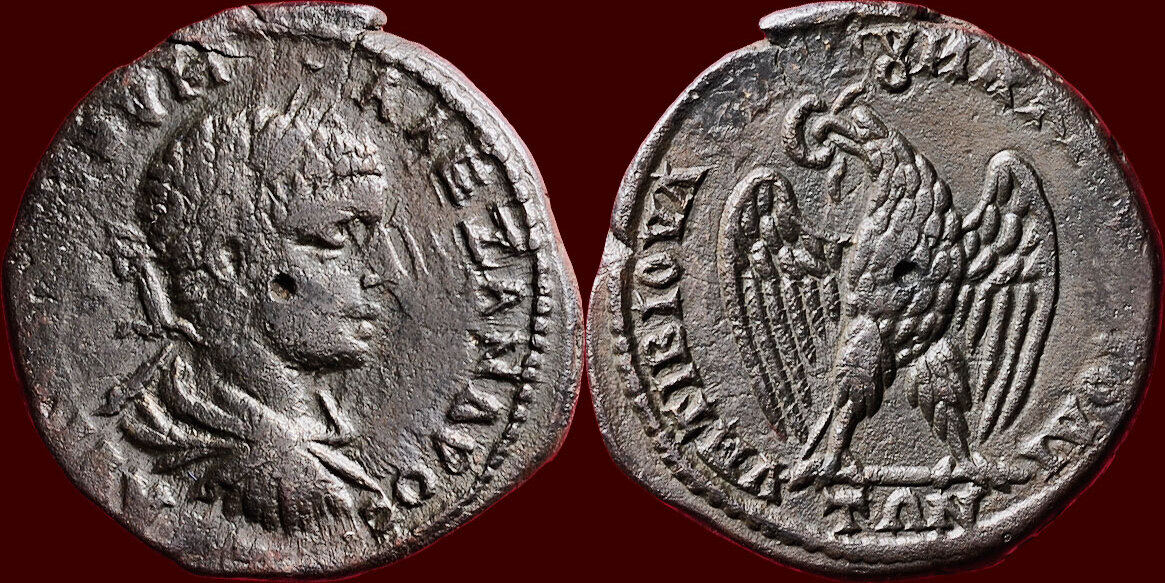
Roman Empire 222-235 n. Chr. SEVERUS ALEXANDER, 222-235 - MOESIA INFERIOR - AE 25, Markianopolis vf-

85,00 EUR
Differenzbesteuert
zzgl. 9,50 EUR Versand ( nach Deutschland )
Lieferzeit: 5 - 8 Tage*
| Bestellhotline +49 (0)2871 2180 383 |
| Zahlungsarten |
| Überweisung |
vf- | Abkürzungen
25,00 mm
weight 8,25gr. | bronze Ø 25mm.
magistrate: Tiberius Iulius Festus (legatus Augusti pro praetore)
obv. Laureate bust of Severus Alexander right, wearing cuirass
and paludamentum, seen from rear, surrounded by the legend
ΑΥΤ Κ Μ ΑΥΡ ϹΕΥΗ ΑΛΕΖΑΝΔΡΟϹ
translation: Emperor Caesar Marcus Aurelius Severus Alexander
rev. Eagle with spread wings facing, head left, holding wreath in beak,
surrounded by the legend ΥΠ ΤΙΒ ΙΟΥΛ ΦΗϹΤΟΥ ΜΑΡΚΙΑΝΟΠΟΛΙ,
ΤΩΝ in exergue
unabridged legend: ΥΠΑΤΕΙΑΣ ΤΙΒΕΡΙΟΥ ΙΟΥΛΙΟΥ ΦΗΣΤΟΥ
ΜΑΡΚΙΑΝΟΠΟΛΙΤΩΝ = during the (pro)consulship of Tiberius
Iulius Festus, of the Marcianopolitans
Tiberius Iulius Festus was a Roman imperial official who served as legatus Augusti pro praetore (consular legate) of Moesia Inferior during the reign of the emperor Severus Alexander. His coins often feature types like an eagle or the goddess Homonoia standing left holding a patera and cornucopia. As a legatus, he represented imperial authority in the province of Moesia Inferior and oversaw local administrative and civic minting operations at Markianopolis during the reign of Severus Alexander. Beyond his presence on these civic bronze coins, little personal or narrative biography survives in literary or epigraphic sources.
On the Roman Provincial coins of Markianopolis (located in modern-day Devnya, Bulgaria), an eagle with spread wings carried three overlapping layers of meaning:
• Primarily, the eagle (Aquila) served as the sacred messenger and direct attribute of the sky god Zeus (or Jupiter to the Romans). In provincial numismatics, depicting the king of the gods′ bird signified supreme power, divine protection, and absolute political authority over the region.
• Imperial Legitimization and Roman Power: Because Markianopolis was a prominent Roman provincial mint, striking coins with the classic Roman imperial eagle projected the might and ubiquity of the Roman Empire. It represented the ever-present authority of the state and the ruling emperor, whose portrait was always stamped on the opposite side.
• Military Connection and Victory: The eagle was famously the standard of the Roman legions (Aquila). On many Markianopolis variants, the eagle with spread wings is depicted standing on a thunderbolt or holding a laurel wreath in its beak. The inclusion of the wreath specifically symbolized victory, triumph, and the loyalty or presence of the Roman military garrisoned in Moesia Inferior.
BMC 73 | AMNG 1020 | SNG.Copenhagen 246 | SNG.München -
SNG.Budapest 226 | Varbanov 1801 | RPC Online VI, 1641
Hristova & Jekov, Marcianopolis 6.32.1.8–11, and 16
Pfeiffer 555-556 R
struck with some minor weaknesses
vf-
Bitte beachten Sie unsere Mindestabnahme von 20 Euro. Sendungen nach China sind auf Gefahr des Käufers und nur Zahlung per banküberweisung. An PayPal und Kreditkarte Zahlungen sind immer Verwaltungs- und Risikokosten verbunden. Sendungen nach Russland, Ukraine und israel sind nicht möglich. Der Versand erfolgt innerhalb von 5 Tagen nach Zahlungseingang. BITTE KEIN PAYPAL ODER KREDITKARTE ZAHLUNGEN FÜR EU. Zahlen Sie bitte immer nur mit IBAN; schnell, billig und zuverlässich.


Informationen zum Kauf bei MA-Shops
Bestellungen bei MA-Shops sind jederzeit möglich und werden innerhalb von 2-4 Arbeitstagen verschickt.
Ein über die MA-Shops abgesicherter Kauf findet niemals außerhalb von MA-Shops statt.
Bestellen Sie sicher online mit dem MA-Shops Warenkorb.
Vielen Dank.
|
Vertrag widerrufen Verkäufer-Startseite | 0Warenkorb | AGB | Impressum | MA AGB | Datenschutzerklärung | Garantie | MA-Shops Neuzugänge Copyright ® 2001-2026, MA-SHOPS Muenzen All Rights Reserved. Designated trademarks and brands are the property of their respective owners. |