

MA-ID: 8854302010
Bewertungen Henzen

Perfect!
Tip-Top Danke
Iedere aankoop dik in orde. Graag tot een volgende keer.
Lot déjà reçu. Envoi impeccable, pièces conformes à la description et en ex...
Gros tournois 1245-1270 FRANCE, KINGDOM - LOUIX IX “THE SAINT”, - n.d. vf/xf à xf-

Munthandel G.Henzen 
11
Seit 11 Jahren bei MA-Shops
8009 Bewertungen,
100 % Positiv (seit 24 Monaten)
Weltweiter Versand
950,00 EUR
Differenzbesteuert
zzgl. 13,00 EUR Versand ( nach Deutschland )
Lieferzeit: 5 - 8 Tage*
zzgl. 13,00 EUR Versand ( nach Deutschland )
| Bestellhotline +49 (0)2871 2180 383 |
| Zahlungsarten |
| Überweisung |
vf/xf à xf- | Abkürzungen
25,50 mm
weight 4,11gr. | silver Ø 25,5mm.
obv. Church building surrounded by the legend ✠ TVRONV.S•CIVIS
within border of dots, surrounded by twelve double-lined arches
with lily inside
rev. Short cross patteé within dotted circle, surrounded by the
legend: ✠LVDOVICVS•REX within dotted circle, surrounded
by the legend ✠BNDICTV⋮SIT⋮NOMЄ⋮DNI⋮NRI⋮DЄI⋮IhV.·XPI
The expanding medieval economy relied heavily on small, lightweight deniers (pennies). Counting thousands of tiny pennies for substantial business transactions was incredibly slow and inefficient. For this reason a heavy silver coin, the ″gros tournois″ was introduced on 24 July by King Louis IX (Saint Louis) of France. The idea was conceived after Louis IX returned from the Seventh Crusade (1248-1254). Historians note he was heavily inspired by the higher-value silver currencies used in the Eastern Mediterranean and the booming Italian city-states (like the Venetian grosso). The gros tournois was a "large penny" weighing about 4.22 grams of high-purity silver. It was worth exactly 12 deniers (equivalent to one sou), allowing merchants to conduct high-value domestic and international trade much more efficiently. By issuing a heavy, stable, and highly pure silver coin (95.8% fineness), he provided a reliable benchmark currency that countered local inflation and attracted foreign commerce. France was fragmented into many feudal entities, many of which minted their own weaker currencies, undermining royal authority. Louis IX used the currency reform to unify the kingdom. An accompanying royal ordinance mandated the use of this currency for all royal payments, helping the monarchy assert fiscal control and supplant local feudal issues. The introduction of the gros tournois proved to be a great international success as well. The gros tournois soon was widely imitated by foreign states throughout Europe, like the Low Countries and Germany. The twelve fleurs-de-lis on the reverse refer to this value. It was made of high-grade silver. The prototype emerged from wrought-iron dies by the moneyers of the beloved Louis IX, warrior king and hero of the Seventh Crusade. The design features the castle of Tours surrounded by a circlet of fleurs-de-lis on the obverse and an ornate cross and ″Ludovicus Rex″ (″King Louis″) on the reverse. A pious legend read ″Benedictus Sit Nomen Domini Dei Jesus Christi″ (″Blessed Be the Name of the Lord Jesus Christ″). For a name, the king reshuffled the roman denarius grossus into gros tournois, which acknowledged the outline of Louis intended the coin to be royal money to serve his entire realm, as opposed to local coins that served town and districts only. The stylistically depicted building on the obverse is consistently referred to as the "Castle of Tours" in numismatic literature and is generally considered the reverse of the coin. I doubt this. Medieval thinking would have been more inclined to endow coins with Christian symbolism. Therefore, I believe it′s more plausible that the Romanesque cathedral of Tours or the Abbey of Tours is depicted here and not the castle of Tours. A central building with a saddle roof flanked by two towers was characteristic of the architectural style of churches at that time. Naturally, we should therefore consider this prominent Christian image the obverse of the coin. The "secular" King Louis IX is subordinate to it and is therefore mentioned in the text on the reverse. cf. Duplessy 190D cf. Ciani 181 | cf. Lafaurie 198c | cf. Roberts 2451 |
cf. Mayhew, Gros tournois in the Haarlo hoard, page 339, no.1 (plate28,1) |
de Mey 28 R
Attractive example with appealing toning. Rare.
vf/xf à xf-
obv. Church building surrounded by the legend ✠ TVRONV.S•CIVIS
within border of dots, surrounded by twelve double-lined arches
with lily inside
rev. Short cross patteé within dotted circle, surrounded by the
legend: ✠LVDOVICVS•REX within dotted circle, surrounded
by the legend ✠BNDICTV⋮SIT⋮NOMЄ⋮DNI⋮NRI⋮DЄI⋮IhV.·XPI
The expanding medieval economy relied heavily on small, lightweight deniers (pennies). Counting thousands of tiny pennies for substantial business transactions was incredibly slow and inefficient. For this reason a heavy silver coin, the ″gros tournois″ was introduced on 24 July by King Louis IX (Saint Louis) of France. The idea was conceived after Louis IX returned from the Seventh Crusade (1248-1254). Historians note he was heavily inspired by the higher-value silver currencies used in the Eastern Mediterranean and the booming Italian city-states (like the Venetian grosso). The gros tournois was a "large penny" weighing about 4.22 grams of high-purity silver. It was worth exactly 12 deniers (equivalent to one sou), allowing merchants to conduct high-value domestic and international trade much more efficiently. By issuing a heavy, stable, and highly pure silver coin (95.8% fineness), he provided a reliable benchmark currency that countered local inflation and attracted foreign commerce. France was fragmented into many feudal entities, many of which minted their own weaker currencies, undermining royal authority. Louis IX used the currency reform to unify the kingdom. An accompanying royal ordinance mandated the use of this currency for all royal payments, helping the monarchy assert fiscal control and supplant local feudal issues. The introduction of the gros tournois proved to be a great international success as well. The gros tournois soon was widely imitated by foreign states throughout Europe, like the Low Countries and Germany. The twelve fleurs-de-lis on the reverse refer to this value. It was made of high-grade silver. The prototype emerged from wrought-iron dies by the moneyers of the beloved Louis IX, warrior king and hero of the Seventh Crusade. The design features the castle of Tours surrounded by a circlet of fleurs-de-lis on the obverse and an ornate cross and ″Ludovicus Rex″ (″King Louis″) on the reverse. A pious legend read ″Benedictus Sit Nomen Domini Dei Jesus Christi″ (″Blessed Be the Name of the Lord Jesus Christ″). For a name, the king reshuffled the roman denarius grossus into gros tournois, which acknowledged the outline of Louis intended the coin to be royal money to serve his entire realm, as opposed to local coins that served town and districts only. The stylistically depicted building on the obverse is consistently referred to as the "Castle of Tours" in numismatic literature and is generally considered the reverse of the coin. I doubt this. Medieval thinking would have been more inclined to endow coins with Christian symbolism. Therefore, I believe it′s more plausible that the Romanesque cathedral of Tours or the Abbey of Tours is depicted here and not the castle of Tours. A central building with a saddle roof flanked by two towers was characteristic of the architectural style of churches at that time. Naturally, we should therefore consider this prominent Christian image the obverse of the coin. The "secular" King Louis IX is subordinate to it and is therefore mentioned in the text on the reverse. cf. Duplessy 190D cf. Ciani 181 | cf. Lafaurie 198c | cf. Roberts 2451 |
cf. Mayhew, Gros tournois in the Haarlo hoard, page 339, no.1 (plate28,1) |
de Mey 28 R
Attractive example with appealing toning. Rare.
vf/xf à xf-
Bitte beachten Sie unsere Mindestabnahme von 20 Euro. Sendungen nach China sind auf Gefahr des Käufers und nur Zahlung per banküberweisung. An PayPal und Kreditkarte Zahlungen sind immer Verwaltungs- und Risikokosten verbunden. Sendungen nach Russland, Ukraine und israel sind nicht möglich. Der Versand erfolgt innerhalb von 5 Tagen nach Zahlungseingang. BITTE KEIN PAYPAL ODER KREDITKARTE ZAHLUNGEN FÜR EU. Zahlen Sie bitte immer nur mit IBAN; schnell, billig und zuverlässich.
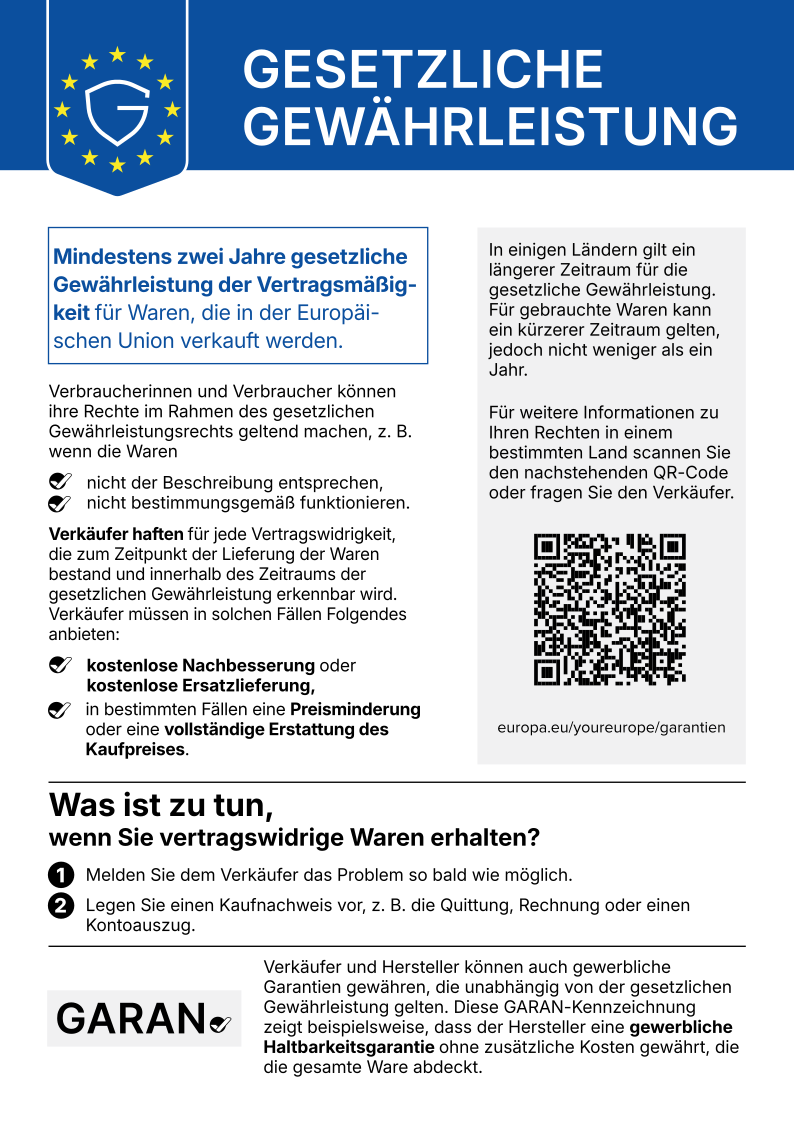

Informationen zum Kauf bei MA-Shops
Bestellungen bei MA-Shops sind jederzeit möglich und werden innerhalb von 2-4 Arbeitstagen verschickt.
Ein über die MA-Shops abgesicherter Kauf findet niemals außerhalb von MA-Shops statt.
Bestellen Sie sicher online mit dem MA-Shops Warenkorb.
Vielen Dank.
Ein über die MA-Shops abgesicherter Kauf findet niemals außerhalb von MA-Shops statt.
Bestellen Sie sicher online mit dem MA-Shops Warenkorb.
Vielen Dank.
|
Vertrag widerrufen Verkäufer-Startseite | 0Warenkorb | AGB | Impressum | MA AGB | Datenschutzerklärung | Garantie | MA-Shops Neuzugänge Copyright ® 2001-2026, MA-SHOPS Muenzen All Rights Reserved. Designated trademarks and brands are the property of their respective owners. |