

Filter und Sortierung

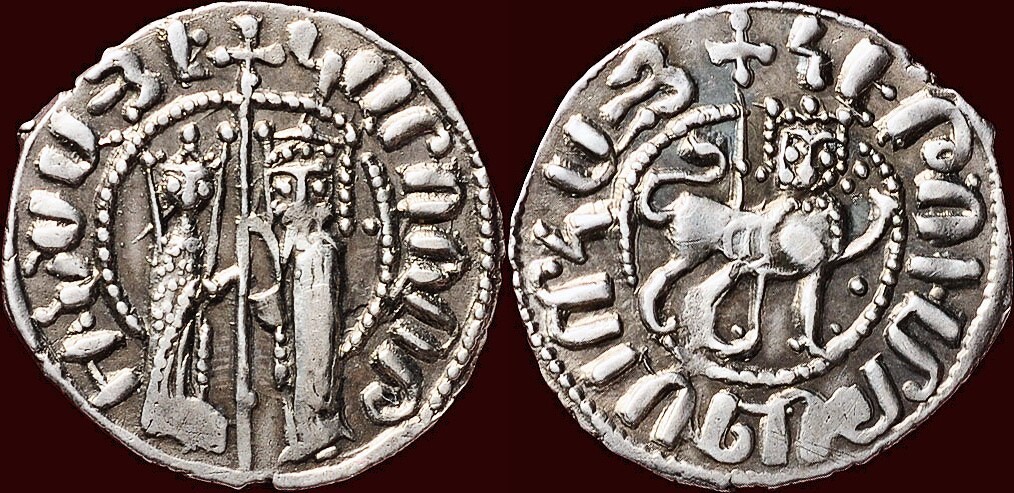
Tram 1226-1270 ARMENIA, KINGDOM - HETOUM I, - n.d. very attractive specimen with fine details

zzgl. 11,00 EUR Versand ( nach Deutschland )
| Bestellhotline +49 (0)2871 2180 383 |
| Zahlungsarten |
| Überweisung |
obv. Queen Zabel standing on left and king Hetoum standing
on right, both crowned, holding a long cross between them,
dot in right field, surrounded by the Armenian legend
✤ԿԱՐՈՂՈԻԹ ԻՆՆ ԱՅ
translation: by the will of God.
rev. Lion walking to right with lifted right paw, crossscepter above,
4 dots in lower field, within dotted circle, surrounded by the
Armenian legend ՀԵԹՈԻՄ ԹԱԳԱԻՈՐ ՀԱՅ
translation: Hetoum king of the Armenians.
Hetoum I was the visionary King of the Armenian Kingdom of Cilicia (1226–1270) and founder of the Hetoumid dynasty. Facing severe threats from Seljuk, Ayyubid, and Mamluk forces, he secured the kingdom′s survival by establishing a strategic, protective alliance with the Mongol Empire. Born around 1215, Hetoum was the son of Constantine, Lord of Baberon and Princess Alix of Lambron. He ascended to the throne in 1226 after being forced to marry Queen Zabel (Isabella). This marriage united the rival factions of the kingdom and established the Hetoumid dynasty.
Queen Zabel (Isabella) of Armenia (1216–1252) was born to King Levon I (the Magnificent) and Sibylla of Cyprus, Zabel became the sole heir to the throne. Following her father′s death in 1219, she was proclaimed Queen. Due to her young age, the kingdom was initially governed by a regency under Constantine of Baberon. To forge regional alliances against neighboring threats, her regents arranged a marriage for Zabel in 1222 to Philip of Antioch. Philip′s attempts to enforce Latin customs and his disregard for Armenian traditions caused outrage, leading to his imprisonment and death by poison in 1225. In 1226, Zabel was married to Hetoum I of the powerful Hetoumid family. Hetoum was crowned co-ruler, and together they successfully unified the kingdom. Their combined rule marked a golden era for Cilician Armenia.
Surrounded by hostile Muslim sultanates, Hetoum initiated a pragmatic foreign policy focused on allying with the rising Mongol Empire. Hetoum undertook a grueling overland expedition to the Mongol capital of Karakorum. There, he successfully negotiated a treaty directly with Möngke Khan, securing protected vassal status, tax exemptions, and military support for Armenian territories. His alliance with the Mongols allowed Armenian troops to fight alongside Mongol forces during the sieges of Baghdad (1258) and Aleppo (1260.
Despite the constant regional warfare, Hetoum′s reign was an era of profound cultural and economic advancement. His policies turned the Armenian port of Ayas into a vital international trading hub, famously facilitating the travels of Marco Polo. The arts, particularly illuminated manuscripts and architecture, flourished under his reign, with the royal court acting as an influential political and cultural center in the Near East.
Following the decline of Mongol dominance in the region, Cilician Armenia became heavily targeted by the Mamluks. The kingdom suffered invasions in 1266, during which Hetoum′s son, the future Levon II, was taken hostage. Hetoum was forced to concede several border territories to secure his release. Weary of war, Hetoum abdicated in 1270 in favor of his son Levon. He spent his final months living as a monk and passed away on 28 October 1270.
variant: dot on cross, one dot in obverse field, four dots
in reverse field. This variant is very rare.
Nercessian 339var. | Bedoukian 949var. cf. Numista 45836 RR
very attractive specimen with fine details
vf/xf à xf-
Bitte beachten Sie unsere Mindestabnahme von 20 Euro. Sendungen nach China sind auf Gefahr des Käufers und nur Zahlung per banküberweisung. An PayPal und Kreditkarte Zahlungen sind immer Verwaltungs- und Risikokosten verbunden. Sendungen nach Russland, Ukraine und israel sind nicht möglich. Der Versand erfolgt innerhalb von 5 Tagen nach Zahlungseingang. BITTE KEIN PAYPAL ODER KREDITKARTE ZAHLUNGEN FÜR EU. Zahlen Sie bitte immer nur mit IBAN; schnell, billig und zuverlässich.

Ein über die MA-Shops abgesicherter Kauf findet niemals außerhalb von MA-Shops statt.
Bestellen Sie sicher online mit dem MA-Shops Warenkorb.
Vielen Dank.
|
Vertrag widerrufen Verkäufer-Startseite | 0Warenkorb | AGB | Impressum | MA AGB | Datenschutzerklärung | Garantie | MA-Shops Neuzugänge Copyright ® 2001-2026, MA-SHOPS Muenzen All Rights Reserved. Designated trademarks and brands are the property of their respective owners. |