

MA-ID: 8826202010
Bewertungen Henzen

Sehr schnelle Lieferung und Münze
tres belle piece. Felicitations
Great coins, fast delivery, all good!
????
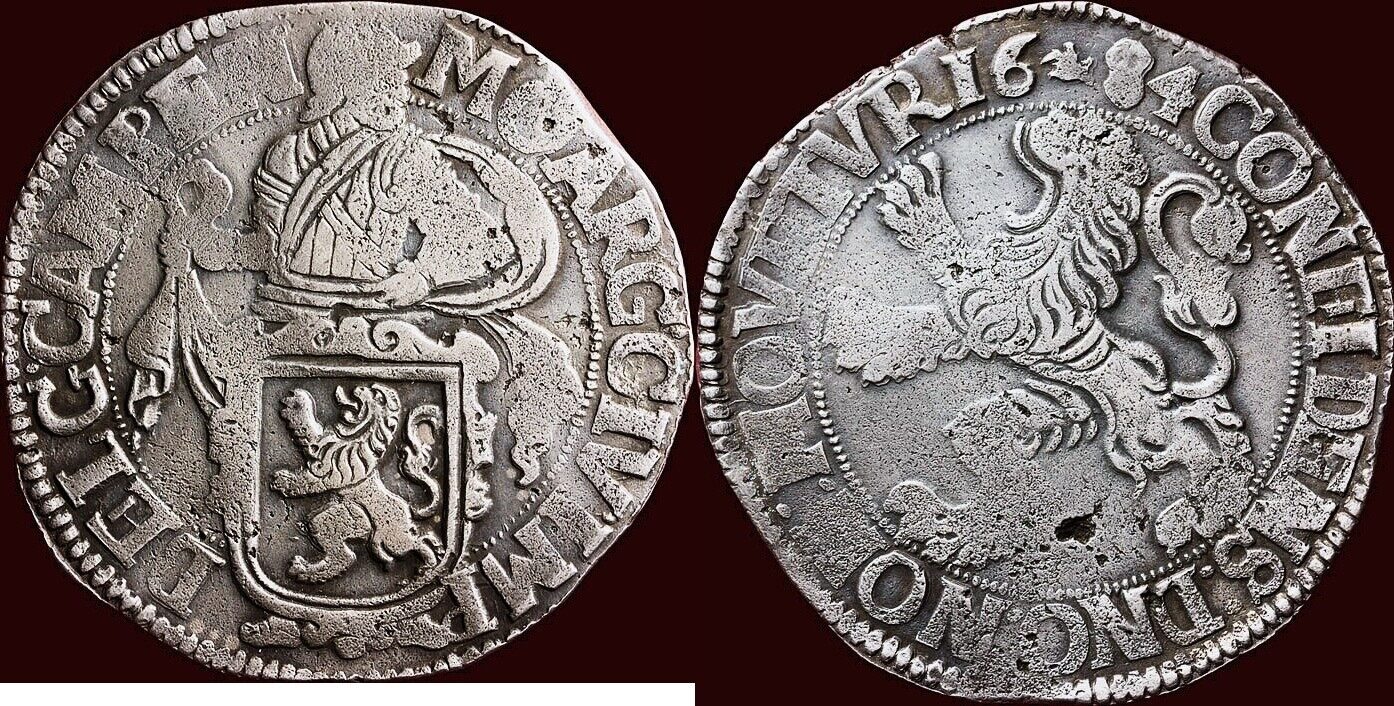
Leeuwendaalder 1684 NOORDELIJKE NEDERLANDEN (NETHERLANDS) - REPUBLIEK, 1581-1795 - OVERIJSSEL - STAD KAMPEN - PERIODE LEOPOLD I, 1657-1705 - zfr-
Munthandel G.Henzen 
11
Seit 11 Jahren bei MA-Shops
8026 Bewertungen,
100 % Positiv (seit 24 Monaten)
Weltweiter Versand
250,00 EUR
Differenzbesteuert
zzgl. 11,00 EUR Versand ( nach Deutschland )
Lieferzeit: 5 - 8 Tage*
zzgl. 11,00 EUR Versand ( nach Deutschland )
| Bestellhotline +49 (0)2871 2180 383 |
| Zahlungsarten |
| Überweisung |
gewicht 26,95gr. | zilver Ø 42mm.
muntmeester: Jacob Ridder
muntmeesterteken: ruiter vz. Geharnaste en gehelmde ridder staande naar links, hoofd naar
rechts gewend, sjerp royaal om zich heen geslagen waarvan hij het
geluste uiteinde in zijn linkerhand houdt, het wapenschild van Holland
binnen een geornamenteerde omlijsting voor zich geplaatst, binnen een
parelcirkel, omringd door de tekst MO˙ARG˙CIV˙IMP – BELG˙CAMPEN
kz. Klimmende Hollandse leeuw naar links binnen een parelcirkel, daarboven
16 ruiter 84, omringd door de tekst :CONFIDENS:DNO:NON:MOVETVR The lion dollar circulated throughout the Middle East and was imitated in several German and Italian cities. It was also popular in the Dutch East Indies as well as in the Dutch New Netherlands Colony (New York). The lion dollar also circulated throughout the English colonies during the Seventeenth and early Eighteenth centuries. Examples circulating in the colonies were usually fairly well worn so that the design was not fully distinguishable, thus they were sometimes referred to as ″dog dollars.″ Larger Dutch silver coins as the ducatoon and the ″rix″ dollar (rijksdaalder) were also used in the colonies but neither of these coins had such a wide circulation or long lasting influence as the lion dollar. In Maryland the lion dollar was mentioned as the most important circulating coin in documents of 1701 and 1708, with its value stated as 4s6d. It is reported by Felt (p. 250) that a deposition was taken in Boston on July 29, 1701 stating that ″Dog or Lion dollars″ had been counterfeited in Massachusetts. In 1708 the New York Assembly set the value of the lion dollar at 5s6d. Also, the New York paper currency emission of November 1, 1709 was issued as amounts of sterling silver expressed in denominations of 4, 8, 16 and 20 lion dollars, with 13.75 oz. of silver equal to 20 lion dollars. Mossman also states lion dollars were used in Pennsylvania, New Jersey and Virginia. In April of 1998 a Mike Cato from Virginia sent me an e-mail that he had discovered a 1640 lion dollar while metal detecting. In the hoard collected from the H.M.S. Feversham, which sank on October 7, 1711 after leaving New York, there were 22 lion dollars (quantitatively third only to the 504 Spanish Colonial silver coins and the 126 specimens of Massachusetts silver). Also, two lion dollars were inventoried in the hoard discovered in Castine, Maine, thought to have been deposited there in 1704 by French colonists fleeing from the English. It should be recalled that most of the Castine hoard was dispersed before an inventory could be produced. Lion dollars were no longer minted after 1713, during the Eighteenth century they were replaced in the Mideast by the Austrian thaler. In the English colonies New World Spanish silver had always held first place and with the advent of the famous milled silver coinage in 1732, the Spanish milled dollar absorbed the lion dollar′s share of the market. Delmonte 862 | Verkade 163.1 | HNPM.29
CNM.2.30.41 | Davenport 4879 R
Kleine gietgal en de gebruikelijke zwaktes van de slag. Zeldzaam.
zfr-
Bitte beachten Sie unsere Mindestabnahme von 20 Euro. Sendungen nach China sind auf Gefahr des Käufers und nur Zahlung per banküberweisung. An PayPal und Kreditkarte Zahlungen sind immer Verwaltungs- und Risikokosten verbunden. Sendungen nach Russland, Ukraine und israel sind nicht möglich. Der Versand erfolgt innerhalb von 5 Tagen nach Zahlungseingang. BITTE KEIN PAYPAL ODER KREDITKARTE ZAHLUNGEN FÜR EU. Zahlen Sie bitte immer nur mit IBAN; schnell, billig und zuverlässich.


Informationen zum Kauf bei MA-Shops
Bestellungen bei MA-Shops sind jederzeit möglich und werden innerhalb von 2-4 Arbeitstagen verschickt.
Ein über die MA-Shops abgesicherter Kauf findet niemals außerhalb von MA-Shops statt.
Bestellen Sie sicher online mit dem MA-Shops Warenkorb.
Vielen Dank.
Ein über die MA-Shops abgesicherter Kauf findet niemals außerhalb von MA-Shops statt.
Bestellen Sie sicher online mit dem MA-Shops Warenkorb.
Vielen Dank.
|
Vertrag widerrufen Verkäufer-Startseite | 0Warenkorb | AGB | Impressum | MA AGB | Datenschutzerklärung | Garantie | MA-Shops Neuzugänge Copyright ® 2001-2026, MA-SHOPS Muenzen All Rights Reserved. Designated trademarks and brands are the property of their respective owners. |