

MA-ID: 8823202010
Bewertungen Henzen

????
Perfect!
Tip-Top Danke
Iedere aankoop dik in orde. Graag tot een volgende keer.
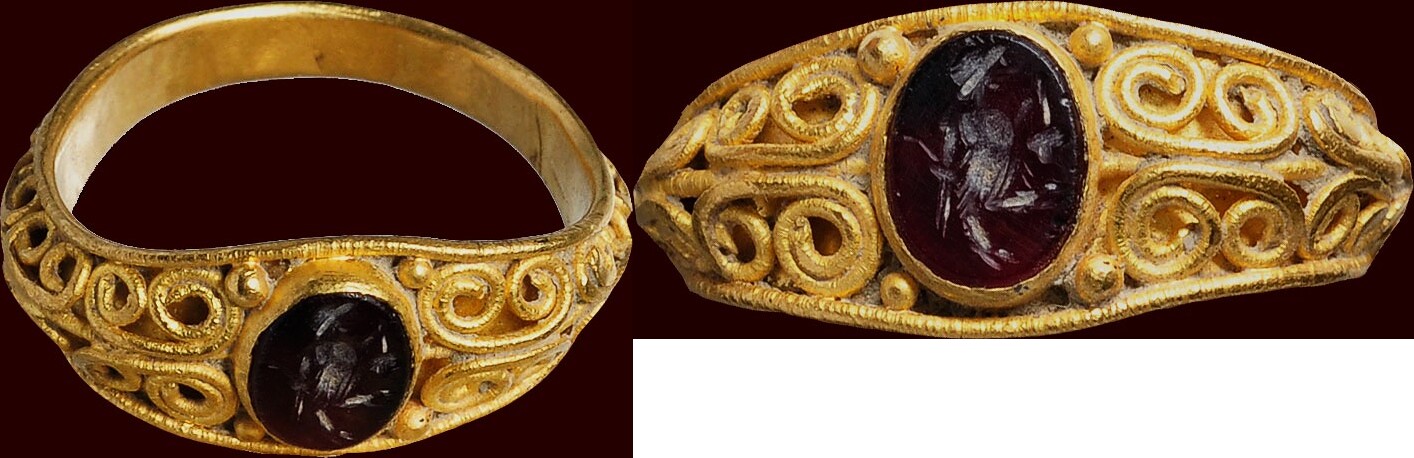
ARCHAEOLOGICAL OBJECT - ROMAN TIMES - Gold ring with Carnelian intaglio, circa 2nd / 3rd century AD Richly decorated gold ring in which the band widens towards the center, with a dark red carnelian in the center. The ring is inl
Munthandel G.Henzen 
11
Seit 11 Jahren bei MA-Shops
8017 Bewertungen,
100 % Positiv (seit 24 Monaten)
Weltweiter Versand
4850,00 EUR
Differenzbesteuert
zzgl. 18,00 EUR Versand ( nach Deutschland )
Lieferzeit: 5 - 8 Tage*
zzgl. 18,00 EUR Versand ( nach Deutschland )
| Bestellhotline +49 (0)2871 2180 383 |
| Zahlungsarten |
| Überweisung |
Richly decorated gold ring in which the band widens towards the center, with a dark red carnelian in the center. The ring is inl | Abkürzungen
20,00 mm
weight 5,97gr. | gold | inside measures circa Ø 20mm.
Richly decorated gold ring in which the band widens towards the center, with a dark red carnelian in the center. The ring is inlaid all around with fine filigree with spectacle-like motifs. On the carnelian, we see the deity Faunus (Pan) depicted with goat′s legs. As attributes, he holds a pedum in his downward-hanging right hand, while holding a bunch of grapes in his forward-held left hand. The ancient Romans considered jewellery to be an essential accessory, for it provided a public display of their wealth. Roman jewellery at first followed trends set by the Etruscans, using gold and glass beads, but as the power and spread of the Roman Empire increased, so too did jewellery designs become increasingly elaborate. Different cultural styles from Greece, Egypt, North Africa, and the Orient were all incorporated to reflect Rome′s prosperity as a dominant, conquering civilisation. The custom of wearing rings was likely introduced by the Sabines, who are described in early legends as wearing gold rings with precious stones. During the Roman Republic it became customary for all the senators, chief magistrates, and at last for the equites also, to wear gold rings, as a way to distinct themselves from the mass of the people. Both men and women would have worn multiple rings on each finger, competing in vanity for the one having the bigger or heavier ring. The extremely sophisticated technique of engraving of gemstones was one of the most luxurious art forms in the Ancient World. Furthermore, in Ancient Roman culture gemstones were amongst the most expensive and lavish objects and were prized above all other possessions. When Greece and Rome merged culturally, the Romans adopted Pan′s iconography and myths into their own native deity, Faunus. Both gods were patrons of shepherds, hunters, meadows, and wild, untamed nature. While Faunus was originally an Italian forest spirit without goat legs, Roman art and literature began depicting him as a satyr a horned, goat-legged figure. Faunus played a major role in one of Rome′s most enduring rituals: the Lupercalia. Held annually in mid-February, this ancient fertility festival celebrated Faunus and the founding of Rome. Young men, dressed in goat-skins, ran through the streets to bless the people, promote agricultural fertility, and ward off evil spirits.
provenance Dutch private collection.
Acquired on the Dutch art market in the 1980′s ♦ Fantastic little masterpiece of Roman goldsmithing ♦
intact
Bitte beachten Sie unsere Mindestabnahme von 20 Euro. Sendungen nach China sind auf Gefahr des Käufers und nur Zahlung per banküberweisung. An PayPal und Kreditkarte Zahlungen sind immer Verwaltungs- und Risikokosten verbunden. Sendungen nach Russland, Ukraine und israel sind nicht möglich. Der Versand erfolgt innerhalb von 5 Tagen nach Zahlungseingang. BITTE KEIN PAYPAL ODER KREDITKARTE ZAHLUNGEN FÜR EU. Zahlen Sie bitte immer nur mit IBAN; schnell, billig und zuverlässich.


Informationen zum Kauf bei MA-Shops
Bestellungen bei MA-Shops sind jederzeit möglich und werden innerhalb von 2-4 Arbeitstagen verschickt.
Ein über die MA-Shops abgesicherter Kauf findet niemals außerhalb von MA-Shops statt.
Bestellen Sie sicher online mit dem MA-Shops Warenkorb.
Vielen Dank.
Ein über die MA-Shops abgesicherter Kauf findet niemals außerhalb von MA-Shops statt.
Bestellen Sie sicher online mit dem MA-Shops Warenkorb.
Vielen Dank.
|
Vertrag widerrufen Verkäufer-Startseite | 0Warenkorb | AGB | Impressum | MA AGB | Datenschutzerklärung | Garantie | MA-Shops Neuzugänge Copyright ® 2001-2026, MA-SHOPS Muenzen All Rights Reserved. Designated trademarks and brands are the property of their respective owners. |