

Filter und Sortierung
Bewertungen Henzen

Zoals altijd snelle levering. Produkt als omschreven. Topverkoper!
ik ben heel tevreden keurig geleverd en goede kwaliteit
Nice coin. Well packaged. Good accompanying description.
Excellent!
MA-ID: 8791702010
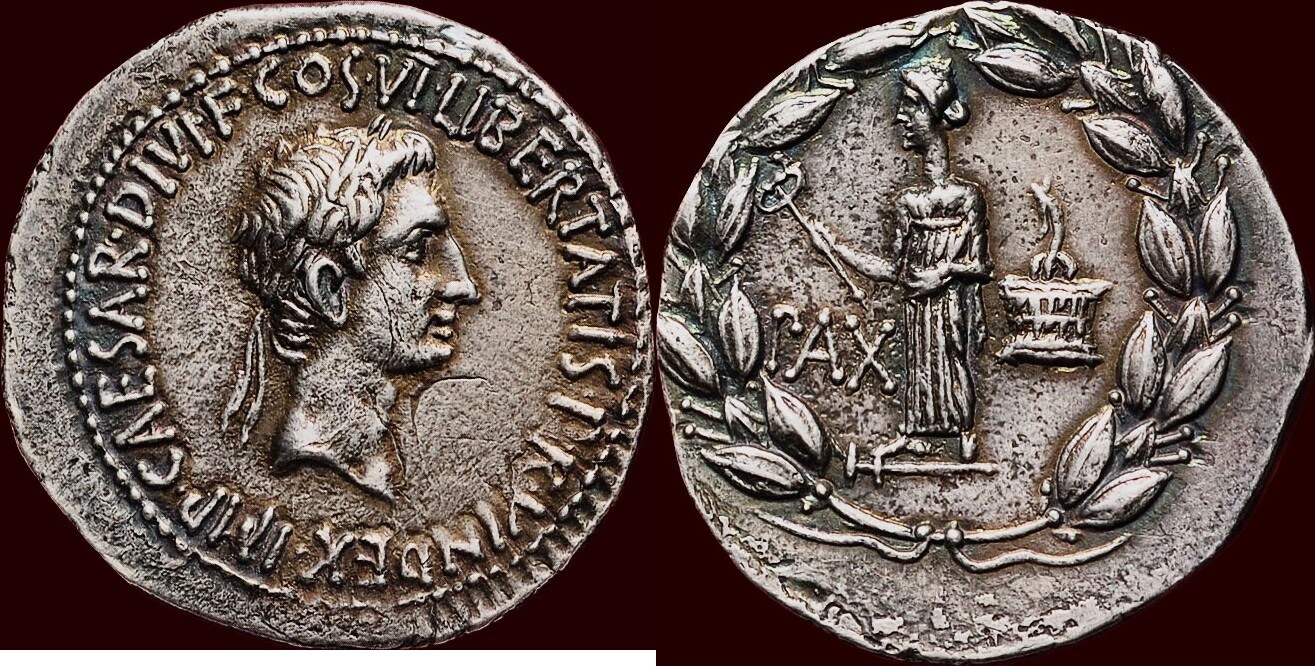
AR Cistophoros ROMAN IMPERATORS - OCTAVIANUS (OCTAVIAN) - Ephesos xf-

4250,00 EUR
Differenzbesteuert
zzgl. 18,00 EUR Versand ( nach Deutschland )
Lieferzeit: 5 - 8 Tage*
zzgl. 18,00 EUR Versand ( nach Deutschland )
| Bestellhotline +49 (0)2871 2180 383 |
| Zahlungsarten |
| Überweisung |
xf- | Abkürzungen
28,00 mm
weight 11,83gr. | silver Ø 28mm.
obv. Laureate head of Octavianus right, surrounded by the legend
IMP CAESAR DIVI F COS VI LIBERTATIS P R VINDEX
rev. Pax standing left on parazonium (?), holding caduceus in right
hand, Cista Mystica with snake emerging in right field, PAX in left
field, all within laurel-wreath
The traditional denomination of the province of Asia, with its origins dating back to the time of the later Pergamene kings, the cistophorus, was minted extensively under Augustus. The cistophoric tetradrachm had the value of 3 denarii. Production was more restricted under most successors and Claudius was the only other emperor amongst the Julio-Claudians to issue cistophorii. There was a resumption of production from later Flavian times until Hadrian, the volume of whose Asian silver rivalled that of Augustus himself, but thereafter there was an abrupt cessation of minting. An isolated late revival came early in the 3rd century under Septimius Severus.
These were the first silver cistephorii to be minted in Asia in over a decade, since Antony′s issue depicting himself and his new bride Octavia in 39 BC. The mint was probably located in Ephesos, the likely source of the earlier series, and the issue marked the beginning of a vast output of cistophorii extending over the following decade. Ephesos and Pergamon both seem to have participated in this later coinage which, interestingly, seems to coincide with the lengthy interruption in the production of aurei and denarii in Italy. For the first time Octavianus is depicted laureate instead of bare-headed, as a god. It was fitting that this should have occurred first on an issue from the East where the concept of a divine monarchy was deeply rooted. The wreath of laurel doubtless refers to Apollo with whom Octavianus had had a special relationship ever since Actium. The message conveyed by the legends and the reverse type leave no room for ambiguity. In a remarkably lengthy obverse inscription Octavianus is proclaimed as the ′Champion of the Liberty of the Roman People′, whilst the figure of Pax on reverse, firmly identified by the accompanying inscription, gives promise of the peace which will now be bestowed on a troubled world through Octavianus′ triumph over his enemies, who were also the enemies of Rome. The traditional cista, or snake basket, is relegated to a minor symbol in the reverse field, whilst the whole is encircled by Apollo′s wreath of laurel instead of the Dionysiac garland of ivy, now tainted by its association with Antony, the ′New Dionysos′.
Exceptional portrait style, much nicer than the typical boyish portrait
that appears on this type. Rare and a very attractive historical coin.
Cohen 218 | RIC 510 | BMC 691 (=BMCRR East 248)
CBN.908 | AMC.673 | RPC.2203 | CRI.433 | Sear 1533 R
some minor roughness
xf-
Bitte beachten Sie unsere Mindestabnahme von 20 Euro. Sendungen nach China sind auf Gefahr des Käufers und nur Zahlung per banküberweisung. An PayPal und Kreditkarte Zahlungen sind immer Verwaltungs- und Risikokosten verbunden. Sendungen nach Russland, Ukraine und israel sind nicht möglich. Der Versand erfolgt innerhalb von 5 Tagen nach Zahlungseingang. BITTE KEIN PAYPAL ODER KREDITKARTE ZAHLUNGEN FÜR EU. Zahlen Sie bitte immer nur mit IBAN; schnell, billig und zuverlässich.

Informationen zum Kauf bei MA-Shops
Bestellungen bei MA-Shops sind jederzeit möglich und werden innerhalb von 2-4 Arbeitstagen verschickt.
Ein über die MA-Shops abgesicherter Kauf findet niemals außerhalb von MA-Shops statt.
Bestellen Sie sicher online mit dem MA-Shops Warenkorb.
Vielen Dank.
Ein über die MA-Shops abgesicherter Kauf findet niemals außerhalb von MA-Shops statt.
Bestellen Sie sicher online mit dem MA-Shops Warenkorb.
Vielen Dank.
|
Vertrag widerrufen Verkäufer-Startseite | 0Warenkorb | AGB | Impressum | MA AGB | Datenschutzerklärung | Garantie | MA-Shops Neuzugänge Copyright ® 2001-2026, MA-SHOPS Muenzen All Rights Reserved. Designated trademarks and brands are the property of their respective owners. |