

MA-ID: 8680202010
Bewertungen Henzen

????
Perfect!
Tip-Top Danke
Iedere aankoop dik in orde. Graag tot een volgende keer.
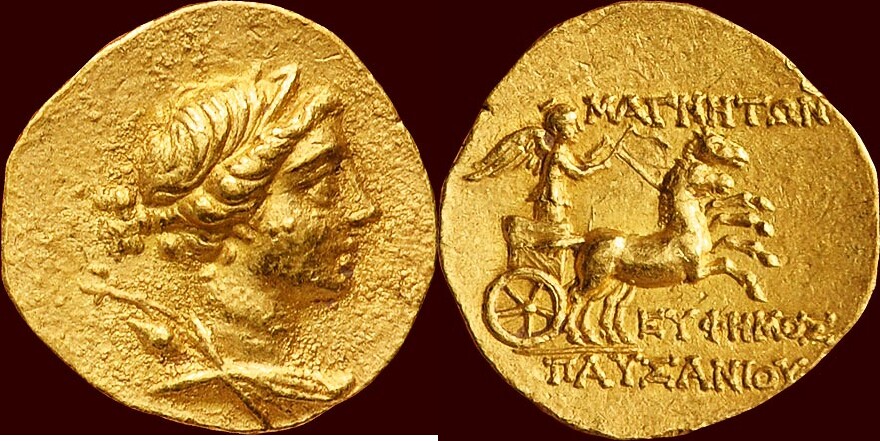
AV Stater 125-120 v. Chr. IONIA, MAGNESIA ON THE MAEANDER (AD MAEANDRUM) - EUPHEMOS,SON OF PAUSANIAS, magistrate - circa 125-120 BC cf. CNG Auction 106, 13 September 2017, Lot 376 (in vf+ : USD 13.000 + 18%)
Munthandel G.Henzen 
11
Seit 11 Jahren bei MA-Shops
8016 Bewertungen,
100 % Positiv (seit 24 Monaten)
Weltweiter Versand
9750,00 EUR
Differenzbesteuert
zzgl. 18,00 EUR Versand ( nach Deutschland )
Lieferzeit: 5 - 8 Tage*
zzgl. 18,00 EUR Versand ( nach Deutschland )
| Bestellhotline +49 (0)2871 2180 383 |
| Zahlungsarten |
| Überweisung |
cf. CNG Auction 106, 13 September 2017, Lot 376 (in vf+ : USD 13.000 + 18%) | Abkürzungen
19,00 mm
weight 8,43gr. | gold Ø 19mm.
obv. Draped bust of Artemis right, wearing stephanos, hair drawn
together and tied in the back, bow and quiver over shoulder
rev. Nike, holding kentron in right hand, reins in left, driving fast
biga of horses right MAΓNH(TΩN) above, EYΦHMOΣ ΠAYΣANIOY
in two lines below
The town of Magnesia, which Strabo saw, was remarkable for its temple of Artemis Leukophryene, which in size and the number of its treasures was surpassed by the temple of Ephesus, but in beauty and the harmony of its parts was superior to all the temples in Asia Minor. The temple to Artemis is said by Vitruvius to have been built by the architect Hermogenes, in the Ionic style. The name on this issue is the same as that on an issue of stephanephori that was struck circa 150-140 BC. Whether these two issues name the same individual is uncertain. In his study of the stephanephoroi of Magnesia, Jones connected that individual with the neokoros of the temple of Artemis Leukophryene named in an inscription dated to 112/1 BC (IC III iv 9). If this is correct, then it would be reasonable to assume that this individual was also responsible for the present issue of staters. It is also possible that these similarly-named individuals were two members of the same family, such as a grandfather and grandson. The appearance of this previously unknown issue at Magnesia adds another city of western Asia Minor to the list of those that struck a gold coinage in the late Hellenistic period. Previously, such issues were known at Ephesos, Miletos, Smryna, and Tralles. Until Jenkins′ study of the Ephesos staters in 1987 (see Jenkins, Hellenistic), all of these were previously thought to have been issues struck in celebration of Mithradates VI′s liberation of the cities from Roman control. With the exception of Smyrna and a discrete portion of the issues of Ephesos, all are now known to have been struck in the mid-late 2nd century BC, as there are direct parallels between the staters and various cistophori struck in their respective cities. All of these staters are civic in nature, featuring the patron deity of the city on the obverse, and reverses referencing aspects of each city′s particular civic identity. The fact that Magnesia did not strike cistophori is one aspect that separates the present issue from the other cities′ gold. Thus, the dating of the issue relies upon the assumption that the ″magistrate″ named is the same as that found on the stephanophoroi, as noted above. The reverse design also distinguishes this issue. While the obverse is unexceptional, featuring the same profile portrait of Artemis found on the stephanephoroi and later bronze issues, the reverse with Nike driving a fast biga is quite perplexing, as it does not apparently represent an aspect of the civic mythology or identity, but rather an actual event. The type likely commemorates some victory that had a local significance, but our knowledge of Magnesia′s history in the second century BC is scant. There are no political or military actions that are known for the period, but the type may be related to the games of the Leukophryena, which was an important panhellenic festival in honor of Artemis Leukophryene. If the ″magistrate″ named on the coin is the individual who held the position of the temple neokoros in 112/1 BC, then such a connection is quite likely.
It is possible that the individuals named on the Magnesian coins were not officials, but wealthy men who performed a Leiturgeia, a work for the state (in this case, a donation that enabled the coins to be minted), and were therefore honoured by having their names mentioned on the coins. See Jones, Wreathed Tetradrachms of Magnesia, in: ANSMN 24 (1979), p. 81. This coin type has only been known since a recent coin hoard was discovered. That is why it is missing from older reference literature. Only since about 2016 have these gold staters been offered for sale with any regularity. This type of coin was probably only minted for a short period of time, and exclusively in the name of Euphemos, the son of Pausanias. Although always somewhat weakly struck with die rust on the obverse, these coins were probably not or hardly ever in circulation. No higher quality specimens exist. They also no longer cost €30,000–40,000, as they did in the beginning, but are now much more affordable and therefore accessible to a wider audience.
A remarkable type of coin, most likely minted to commemorate a
victory, either military or during a sporting event. Very rare. cf. CNG Auction 106, 13 September 2017, Lot 376 (in vf+ : USD 13.000 + 18%)
BMC - | Sear - | SNG.von Aulock- | SNG.Copenhagen -
Weber collection - | Lindgren collection- | McClean-
SNG.München - | SNG.Tübingen - | Delepierre - | Pozzi -
Jameson - | Ellis-Evans in FS Ashton (2021), Group A. RR
xf
Bitte beachten Sie unsere Mindestabnahme von 20 Euro. Sendungen nach China sind auf Gefahr des Käufers und nur Zahlung per banküberweisung. An PayPal und Kreditkarte Zahlungen sind immer Verwaltungs- und Risikokosten verbunden. Sendungen nach Russland, Ukraine und israel sind nicht möglich. Der Versand erfolgt innerhalb von 5 Tagen nach Zahlungseingang. BITTE KEIN PAYPAL ODER KREDITKARTE ZAHLUNGEN FÜR EU. Zahlen Sie bitte immer nur mit IBAN; schnell, billig und zuverlässich.


Informationen zum Kauf bei MA-Shops
Bestellungen bei MA-Shops sind jederzeit möglich und werden innerhalb von 2-4 Arbeitstagen verschickt.
Ein über die MA-Shops abgesicherter Kauf findet niemals außerhalb von MA-Shops statt.
Bestellen Sie sicher online mit dem MA-Shops Warenkorb.
Vielen Dank.
Ein über die MA-Shops abgesicherter Kauf findet niemals außerhalb von MA-Shops statt.
Bestellen Sie sicher online mit dem MA-Shops Warenkorb.
Vielen Dank.
|
Vertrag widerrufen Verkäufer-Startseite | 0Warenkorb | AGB | Impressum | MA AGB | Datenschutzerklärung | Garantie | MA-Shops Neuzugänge Copyright ® 2001-2026, MA-SHOPS Muenzen All Rights Reserved. Designated trademarks and brands are the property of their respective owners. |