


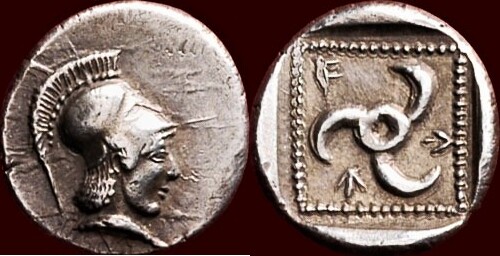
AR 1/6 Stater 440-430 v. Chr. LYCIAN DYNASTS - WEKHSSERE I, CIRCA 440-430 BC - or diobol, uncertain mint (maybe Patara) cf. Numismatica Genevensis, auction 6, lot 103 (in vf/xf | CHF 4.000 + 15%)

zzgl. 18,00 EUR Versand ( nach Deutschland )
| Bestellhotline +49 (0)2871 2180 383 |
| Zahlungsarten |
| Überweisung |
weight 1,33gr. | silver Ø 11mm.
obv. Helmeted head of Athena right, wearing Corinthian helmet
rev. Triskeles, around the Lycian legend F - ↑ - ↑( = WEKH ),
all within dotted square within incuse square
The ruins of Patara are located within the boundaries of the village of Gelemis, a region of Kas, in Antalya province. The city, which was the sea gate of West Lycia to the world, was built on two sides of a inlet that ran inland for 2 km. The Lycians, who founded Patara and were called Tremilae or Termilae, were resident in today′s Dirmil (Burdur) they were not from Crete as Herodotus wrote. They called their country Trmis in their own native language, they called themselves Trmili in the Lycian sense, and they spoke a native language related to Luwian that is one of the earliest known languages of Anatolia. With the archaeological findings uncovered in Patara, the history of the city goes back to the Early Bronze Age. The earliest written document in which the city is mentioned is dated to the 13th century BC in Yalburt, the Luvice temple′s hieroglyphic inscription. The great Hittite King IV Tuthaliya related about his campaigns in the Lukka region and it′s said that he had made offerings and gifts, had erected steles and constructed sacred places in front of Patar Mountain.
The architectural and ceramic finds unearthed in Tepecik date back to the 10th-7th century BC, Patara without interruption passed from the Hittite Lukka to Homeric Lycian. Around 540 BC the city was connected with the Persian commander Harpagos and the Persians, who came from Caria. In 516/15 BC the city was connected to the ′First Satrap′ in Sardis after the 469/68 Eurymedon Naval War, he joined the Attica-Delos Naval Union. The development of the area is confirmed by the fact that coins were minted in Patara by Dynast Wekhssere I in 450-430/25 and Wekhssere II in 430/20-410/ 400 BC.
The Lycians, an autochthonous ethnos, inhabited a mountainous land with little access from its rugged coastline geography fostered independence and discouraged attempts by outsiders to impose control. The dynasts first come into view circa 540 BC. They and their people were subject to the rule of the Persian king and his satraps between 546-470 BC and from circa 400-360 BC. Te Lycians joined the Satraps′ Revolt (which had collapsed by 362 BC) and were defeated by their neighbour Mausollos of Caria, who then added Lycia to the lands of his satrapy and brought an end to the rule of local dynasts.
The early Lycian interest in portraiture in sculpture and on coins can be attributed to a taste for employing the forms and themes of Greek art to express the political status and ambitions of local rulers whose culture and outlook had little in common with the Greeks. They also borrowed from the iconography and practices of their more powerful overlords, the Persians. But portraiture was a feature of Greek art. Greek artists had established ′defining features′ for the representation of deities and heroesduring the archaic period and in the fifth century BC were experimenting with the depiction of men.
The frequent occurrence of Athena on Lycian coins certainly has to do with the expansion of the Athenian naval league. As a result of Athenian imperialism, Athenian tetradrachms bearing the image of Athena became widespread and were among the most commonly-used means of payment in the East. However, Athenian expansion was certainly not the cause behind the popularity of Athena images on Lycian coins. This is evidenced by the fact that Lycia returned to align itself more closely with the Persians under Kheriga, but nevertheless continued or even increased to mint coins with depictions of Athena (cf. Keen 1998, 202). We should take greater account of the fact that Lycia′s ′Athena′ is associated with the Asia Minor warrior goddess Malija (cf. Barnett 1974). In this respect, we are dealing rather with depictions of Malija in Greek iconography than with the Greek goddess Athena.
cf. Numismatica Genevensis, auction 6, lot 103 (in vf/xf | CHF 4.000 + 15%)
Fabulous masterpiece of the finest early Classical style. Very rare.
BMC- | SNG.Copenhagen- | SNG.von Aulock- Vismara 46
Babelon, Traité 433 | Slg. Dr. Maag - (Peus Nacchf., Auktion 407)
Slg. Dr. Sayar 126 (Künker, Auktion 402) | Müseler V, 16
Müseler in Gephyra 17 (2019), - RR
xf
Bitte beachten Sie unsere Mindestabnahme von 20 Euro. Sendungen nach China sind auf Gefahr des Käufers und nur Zahlung per banküberweisung. An PayPal und Kreditkarte Zahlungen sind immer Verwaltungs- und Risikokosten verbunden. Sendungen nach Russland, Ukraine und israel sind nicht möglich. Der Versand erfolgt innerhalb von 5 Tagen nach Zahlungseingang. BITTE KEIN PAYPAL ODER KREDITKARTE ZAHLUNGEN FÜR EU. Zahlen Sie bitte immer nur mit IBAN; schnell, billig und zuverlässich.


Ein über die MA-Shops abgesicherter Kauf findet niemals außerhalb von MA-Shops statt.
Bestellen Sie sicher online mit dem MA-Shops Warenkorb.
Vielen Dank.
|
Vertrag widerrufen Verkäufer-Startseite | 0Warenkorb | AGB | Impressum | MA AGB | Datenschutzerklärung | Garantie | MA-Shops Neuzugänge Copyright ® 2001-2026, MA-SHOPS Muenzen All Rights Reserved. Designated trademarks and brands are the property of their respective owners. |