

MA-ID: 8600602010
Bewertungen Henzen

tres belle piece. Felicitations
Great coins, fast delivery, all good!
????
Perfect!
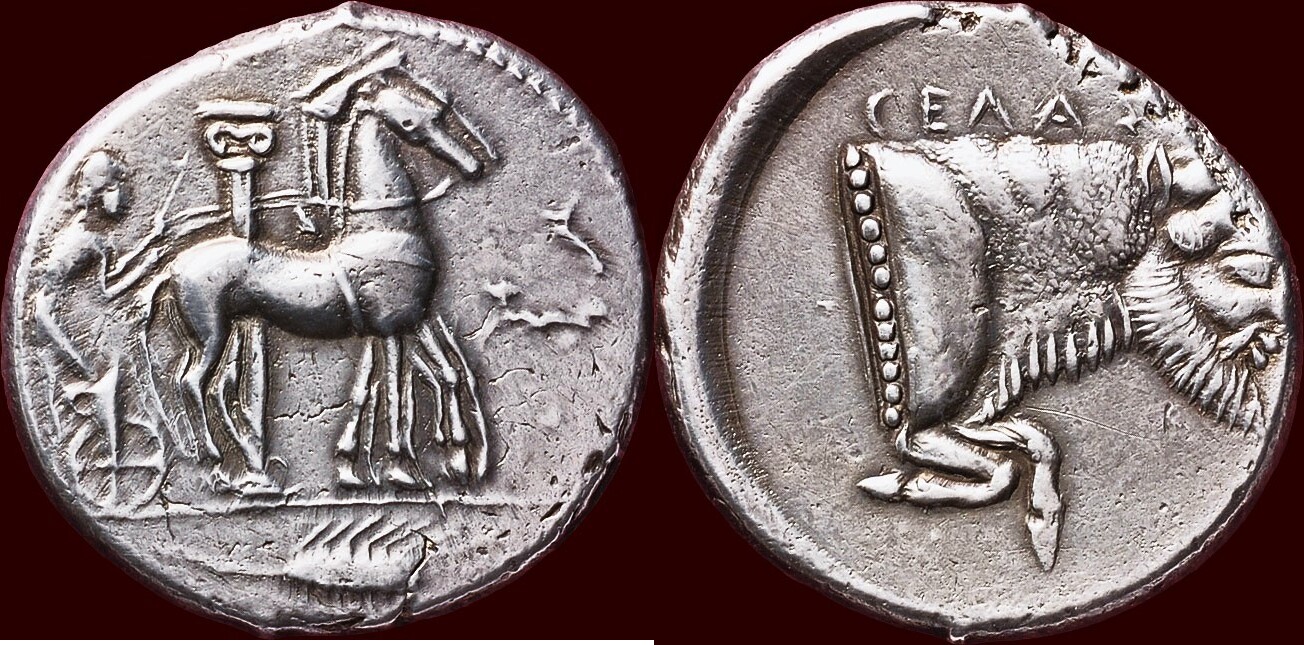
AR Tetradrachm 465-450 v. Chr. SICILIA (SICILY), GELA - circa 465-450 BC cf. NAC, auction 134, Lot 183 in about xf (SFR 38.000 + 22%)
Munthandel G.Henzen 
11
Seit 11 Jahren bei MA-Shops
8025 Bewertungen,
100 % Positiv (seit 24 Monaten)
Weltweiter Versand
12500,00 EUR
Differenzbesteuert
zzgl. 18,00 EUR Versand ( nach Deutschland )
Lieferzeit: 5 - 8 Tage*
zzgl. 18,00 EUR Versand ( nach Deutschland )
| Bestellhotline +49 (0)2871 2180 383 |
| Zahlungsarten |
| Überweisung |
cf. NAC, auction 134, Lot 183 in about xf (SFR 38.000 + 22%) | Abkürzungen
27,00 mm
weight 17,27gr. | silver Ø 27mm.
Group III series (Jenkins).
obv. Charioteer, holding kentron and reins, driving slow quadriga right
Ionic column (terma) behind, grain ear in exergue
rev. Forepart of man-headed bull right CEΛAΣ above
Gela was found by colonists from Rhodes and Crete in 688 BC and was located on the south-eastern coastal plain of Sicily along the banks of the river Gela, from which it reaped a fertile soil and bountiful harvests. By the early fifth century, the wealth generated from its hinterland allowed the city′s early tyrants to expand militarily at the expense of its neighbors, and Gela soon dominated several cities, amongst them Leontinoi, Naxos, Zankle-Messana and Syracuse. The tyrant Gelon, after conquering Syracuse, moved there, leaving his brother Hieron I in charge of Gela. After Gelon′s death in 478 BC, Hieron took control of Syracuse and left the city of Gela to Polyzelos. When Hieron I died, the tyranny of Syracuse was usurped by his brother Thrasyboulos, who it appears had corrupted the son of Hieron into an odious youth, that he might more easily set him aside and take the throne for himself. According to Diodorus (XI, 67) his rapacity and cruelty soon provoked a revolt at Syracuse, which Thrasyboulos sought to crush using foreign mercenaries and troops from Aetna and Katane. The Syracusans entrenched themselves in the quarter of the city called Tyche, and sent requests for assistance to Gela, Akragas, Selinos, Himera and the other inland cities of Sicily. Gela and the other cities responded, and dealt Thrasyboulos a decisive defeat on land and sea, forcing his abdication and retirement into exile.
The Group III tetradrachms were struck an appreciable interval after the last issue of Group II, and appear to have been coined at the time of the expedition to Syracuse as the means of meeting the implicit expense of the campaign. The most distinctive feature of the obverse die is the Ionic column in the background, which it is reasonable to assume is a terma, or turning point. The terma is included as a stylistic and cultural symbol that serves the purpose of being a pleasant architectural adjunct that places the quadriga in a more specific context. The reverse reuses the type from the city′s didrachm coinage, and depicts the forepart of the river-god Gelas.
cf. NAC, auction 134, Lot 183 in about xf (SFR 38.000 + 22%)
Jenkins, Gela 217 | cf. SNG.München - (cf. 279) | cf. SNG.Copenhagen 262
SNG.ANS.- (cf. 50) | SNG.Lloyd 960 | Gillet 413 | McClean- (cf. 2239)
cf. Rizzo pl. XVII, 13 | Sear 789 RR
Reverse slightly struck off-centre, but very attractive piece with fine details.
Attractive style. Very rare.
vf/xf
Bitte beachten Sie unsere Mindestabnahme von 20 Euro. Sendungen nach China sind auf Gefahr des Käufers und nur Zahlung per banküberweisung. An PayPal und Kreditkarte Zahlungen sind immer Verwaltungs- und Risikokosten verbunden. Sendungen nach Russland, Ukraine und israel sind nicht möglich. Der Versand erfolgt innerhalb von 5 Tagen nach Zahlungseingang. BITTE KEIN PAYPAL ODER KREDITKARTE ZAHLUNGEN FÜR EU. Zahlen Sie bitte immer nur mit IBAN; schnell, billig und zuverlässich.


Informationen zum Kauf bei MA-Shops
Bestellungen bei MA-Shops sind jederzeit möglich und werden innerhalb von 2-4 Arbeitstagen verschickt.
Ein über die MA-Shops abgesicherter Kauf findet niemals außerhalb von MA-Shops statt.
Bestellen Sie sicher online mit dem MA-Shops Warenkorb.
Vielen Dank.
Ein über die MA-Shops abgesicherter Kauf findet niemals außerhalb von MA-Shops statt.
Bestellen Sie sicher online mit dem MA-Shops Warenkorb.
Vielen Dank.
|
Vertrag widerrufen Verkäufer-Startseite | 0Warenkorb | AGB | Impressum | MA AGB | Datenschutzerklärung | Garantie | MA-Shops Neuzugänge Copyright ® 2001-2026, MA-SHOPS Muenzen All Rights Reserved. Designated trademarks and brands are the property of their respective owners. |