

MA-ID: 8597402010
Bewertungen Henzen

Sehr schnelle Lieferung und Münze
tres belle piece. Felicitations
Great coins, fast delivery, all good!
????
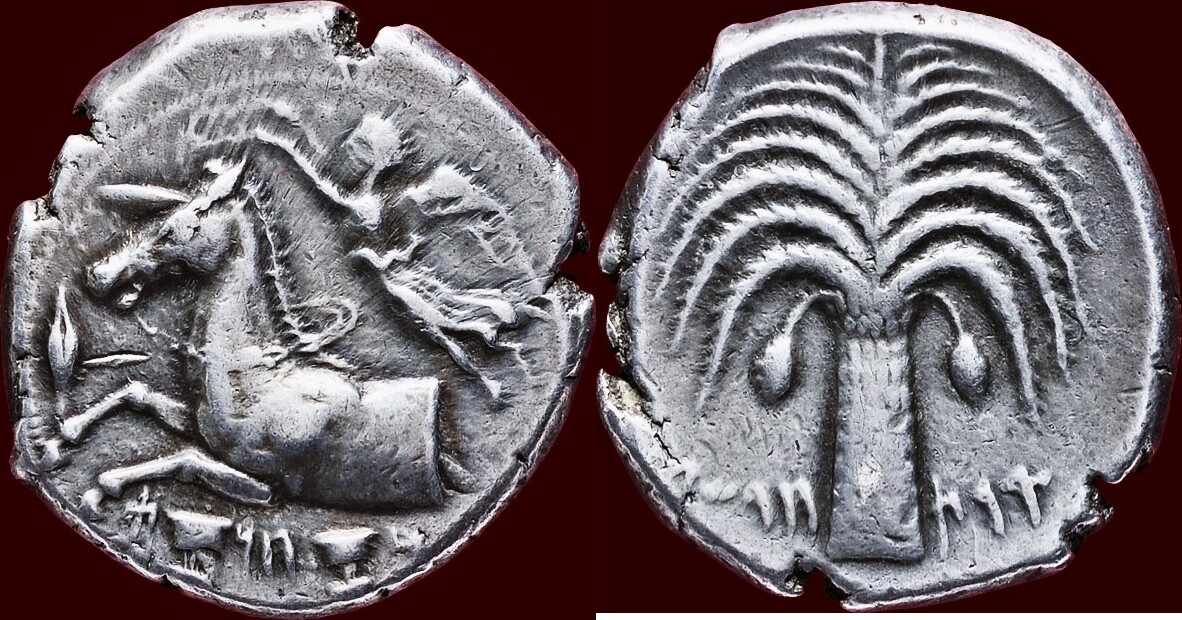
AR Tetradrachm 407-398 v. Chr. CARTHAGIAN EMPIRE - SICILY, ENTELLA (“THE CAMP”) - circa 407-398 BC good vf
Munthandel G.Henzen 
11
Seit 11 Jahren bei MA-Shops
8027 Bewertungen,
100 % Positiv (seit 24 Monaten)
Weltweiter Versand
34500,00 EUR
Differenzbesteuert
zzgl. 18,00 EUR Versand ( nach Deutschland )
Lieferzeit: 5 - 8 Tage*
zzgl. 18,00 EUR Versand ( nach Deutschland )
| Bestellhotline +49 (0)2871 2180 383 |
| Zahlungsarten |
| Überweisung |
good vf | Abkürzungen
25,00 mm
weight 17,36gr. | silver Ø 25mm.
obv. Forepart of galloping bridled horse left,
being crowned by Nike flying left barley grain before,
QRT-H-DST (″Carthage″in Punic) below interposen by two incense-burners
rev. Palm tree with two date cluster
QRT-H-DST (″Carthage″) in Punic across lower field field
In the final decade of the fifth century BC, the Carthaginians launched a series of invasions of Sicily, conquering much of the western half of the island and bringing devastation to many formerly flourishing Greek communities. The Punic presence lasted for a century and a half, until Rome′s victory in the First Punic War obliged the Carthaginians to withdraw. During their time of occupation, the Carthaginians struck an extensive coinage in Sicily for the purpose of financing their military operations and the maintenance of garrisons. The obverse and reverse types of the series are mostly influenced by Sicilian prototypes, particularly those of Syracuse, except for the later series with the head of Herakles on the obverse, which was obviously influenced by the well-recognized coinage of Alexander the Great. While a few of the series are struck at cities with established mints, such as Motya and Panormos, these are often viewed as minor or campaign mints that operated for a short duration. The location of the primary Punic mint (or mints) on Sicily, responsible for the large issues studied by G.K. Jenkins (′Carthage′ series I-V), has been the subject of great debate. Most recently, Ian Lee surveyed the existing literature and took a fresh look at the full spectrum of evidence, persuasively concluding that this mint was located at Entella, the main base of Carthaginian forces in Sicily. (″Entella: The Silver Coinage of the Campanian Mercenaries and the First Carthaginian Mint 410-409 BC″ in NC 160 [2000], pp. 1-66).
Entella was an very ancient city in the interior of Sicily, situated on the left bank of the river Hypsas (modern Belice), and nearly midway between the two seas, being about 40 km from the mouth of the Hypsas, and much about the same distance from the north coast of the island, at the Gulf of Castellamare. Round 407 BC the city of Entella became the most important military base of the Carthagian forces. They were supported by Campanian mercenaries, who had been in the service of the Carthaginians during the war. In 404 BC they put all the male citizens to the sword, to make sure that they would remain masters of the place, successfully. They retained possession of Entella for many years.
Also Carthago and the Sicilian Punic settlement of Lilybaion been suggested in the past as possible mint for this coin type, but Entella seems to be the most likely mint. Only a few examples are known of this coin type. Extremely rare.
Sear- (cf. 6426) | Salinas 67 | Cutroni Tusa 9 | SNG.Copenhagen- (cf.70) |
McClean- (cf.3033) | Jameson- (cf. 907) | Jenkins, SNR II, 53, 1974, nr.37 |
Manfredi 9 | CNP 643 | HGC 2, 264 (R3) RRR
good vf
Bitte beachten Sie unsere Mindestabnahme von 20 Euro. Sendungen nach China sind auf Gefahr des Käufers und nur Zahlung per banküberweisung. An PayPal und Kreditkarte Zahlungen sind immer Verwaltungs- und Risikokosten verbunden. Sendungen nach Russland, Ukraine und israel sind nicht möglich. Der Versand erfolgt innerhalb von 5 Tagen nach Zahlungseingang. BITTE KEIN PAYPAL ODER KREDITKARTE ZAHLUNGEN FÜR EU. Zahlen Sie bitte immer nur mit IBAN; schnell, billig und zuverlässich.

Informationen zum Kauf bei MA-Shops
Bestellungen bei MA-Shops sind jederzeit möglich und werden innerhalb von 2-4 Arbeitstagen verschickt.
Ein über die MA-Shops abgesicherter Kauf findet niemals außerhalb von MA-Shops statt.
Bestellen Sie sicher online mit dem MA-Shops Warenkorb.
Vielen Dank.
Ein über die MA-Shops abgesicherter Kauf findet niemals außerhalb von MA-Shops statt.
Bestellen Sie sicher online mit dem MA-Shops Warenkorb.
Vielen Dank.
|
Vertrag widerrufen Verkäufer-Startseite | 0Warenkorb | AGB | Impressum | MA AGB | Datenschutzerklärung | Garantie | MA-Shops Neuzugänge Copyright ® 2001-2026, MA-SHOPS Muenzen All Rights Reserved. Designated trademarks and brands are the property of their respective owners. |