

MA-ID: 8567502010
Bewertungen Henzen

Great coins, fast delivery, all good!
????
Perfect!
Tip-Top Danke
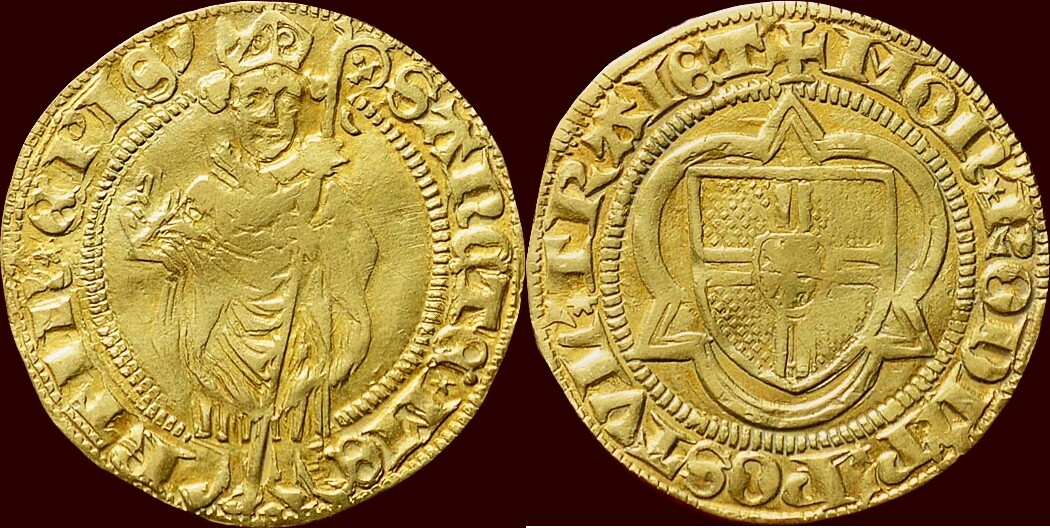
1423-1433 NOORDELIJKE NEDERLANDEN (NETHERLANDS) - BISDOM UTRECHT - RUDOLF VAN DIEPHOLT ALS POSTULAAT, - Postulaat- of bisschopsgulden z.j. zfr
Munthandel G.Henzen 
11
Seit 11 Jahren bei MA-Shops
8022 Bewertungen,
100 % Positiv (seit 24 Monaten)
Weltweiter Versand
6750,00 EUR
Differenzbesteuert
zzgl. 18,00 EUR Versand ( nach Deutschland )
Lieferzeit: 5 - 8 Tage*
zzgl. 18,00 EUR Versand ( nach Deutschland )
| Bestellhotline +49 (0)2871 2180 383 |
| Zahlungsarten |
| Überweisung |
gewicht 3,34gr. | goud Ø 22,5mm.
vz. Sint Maarten, met mijter, staande frontaal met zijn rechterhand
in zegenende houding en in de linker een kromstaf houdend.
In de buitencirkel de tekst SANCTЄ ⋆ MЄ – RTIN⋆ЄPIS′
kz. Wapenschild van het bisdom met het hartschild van Diepholt
binnen een driepas binnen een cirkel. In de buitencirkel de tekst
✠ MON′⋆RODLP′⋆POSTVL′⋆TRAIЄT′
In 1426 werd door de vier Rijnse keurvorsten (Keulen, Trier, Mainz en Pfalz) een nieuw type goudgulden geïntroduceerd conform het Rijnse Muntverbond (Rheinische Münzvertrag). Bij de bisdommen toont op de voorzijde een gemijterde bisschop met kromstaf, zijn rechterhand in zegenende houding, terwijl op de stukken van Pfalz een staande graaf is afgebeeld. De keerzijde toont een wapenschild binnen een driepas. Dit munttype vond weldra ook navolging in het Bisdom Utrecht, waar Rudolf van Diepholt soortgelijke stukken liet slaan. Op de voorzijde wordt echter niet de bisschop verbeeld, maar de heilige Martinus van Tours, de schutspatroon van Utrecht. Aangezien Rudolf van Diepholt wel verkozen was tot bisschop maar nog niet erkend en ingewijd was door de paus, mocht hij de titel van episcopus (bisschop) nog niet voeren en droeg hij derhalve de titel van postulatus (aspirant-bisschop). Reeds in 1428 zien we de eerste meldingen van deze guldens, die spoedig bekend zouden worden als ′postulaatsgulden′. Aangezien Rudolf′s verkiezing tot bisschop aanvankelijk succesvol betwist werd door zijn tegenkandidaat Zweder van Kuilenburg, met de stad Utrecht als machtsbasis, was de situatie in het Nedersticht in de jaren ′1420 zeer onrustig. Rudolf′s machtspositie lag aanvankelijk vooral in het Oversticht en het is ook daar waar we zijn eerste muntslag zien, vooral te Deventer en op kleine schaal ook in Hasselt. Het is meest aannemelijk dat ook deze postulaatsguldens te Deventer zijn geslagen. Gezien de zeldzaamheid van deze stukken zal de productie niet groot zijn geweest. Pas na zijn benoeming tot bisschop in 1433 zien we een grote toename in de productie van goudguldens, vooral na 1435, maar dan met de titel episcopus. Ook die guldens werden tot in de 16e eeuw nog aangeduid als ′postulaatsguldens′, alhoewel die benaming strikt genomen onjuist is.
In 1426, a new type of gold guilder was introduced by the four Rhenish Electors (Cologne, Trier, Mainz and Palatinate) in accordance with the Rhine Mint Association (Rheinische Münzvertrag). The obverse of the dioceses shows a mitered bishop with crozier, his right hand in a blessing position, while the Palatinate pieces depict a standing count. The reverse shows a coat of arms within a trefoil. This coin type was soon imitated in the Diocese of Utrecht, where Rudolf van Diepholt had similar pieces minted. However, the obverse does not depict the bishop, but Saint Martin of Tours, the patron saint of Utrecht. Since Rudolf van Diepholt had been elected bishop but had not yet been recognized and consecrated by the Pope, he was not yet allowed to use the title of episcopus (bishop) and therefore bore the title of postulatus (aspiring bishop). As early as 1428 we see the first reports of these guilders, which would soon become known as ′postulate guilders′. Since Rudolf′s election as bishop was initially successfully contested by his opponent Zweder van Kuilenburg, with the city of Utrecht as a power base, the situation in the Nedersticht was very turbulent in the 1420s. Rudolf′s position of power was initially mainly in the Oversticht and it is also there where we see his first coinage, especially in Deventer and on a small scale also in Hasselt. It is most likely that these postulate guilders were also minted in Deventer. Given the rarity of these pieces, production would not have been large. Only after his appointment as bishop in 1433 do we see a large increase in the production of gold guilders, especially after 1435, but then with the title episcopus. These guilders were also referred to as ′postulate guilders′ until the 16th century, although strictly speaking that name is incorrect.
Delmonte kende slechts 2 exemplaren: collectie Centraal Museum te Utrecht
en collectie De Nederlandsche Bank te Amsterdam. Uiterst zeldzaam.
Delmonte only knew of 2 specimens: the Centraal Museum collection in Utrecht
and the De Nederlandsche Bank collection in Amsterdam. Extremely rare.
van der Chijs plaat XXIX (supplement) | de Mey 279 | Friedberg 184
Delmonte 936 (R3) JMP.2006-2007, pag. 113, no. 1.1.4.2 RRR
lichte zwaktes van de slag
zfr
Bitte beachten Sie unsere Mindestabnahme von 20 Euro. Sendungen nach China sind auf Gefahr des Käufers und nur Zahlung per banküberweisung. An PayPal und Kreditkarte Zahlungen sind immer Verwaltungs- und Risikokosten verbunden. Sendungen nach Russland, Ukraine und israel sind nicht möglich. Der Versand erfolgt innerhalb von 5 Tagen nach Zahlungseingang. BITTE KEIN PAYPAL ODER KREDITKARTE ZAHLUNGEN FÜR EU. Zahlen Sie bitte immer nur mit IBAN; schnell, billig und zuverlässich.


Informationen zum Kauf bei MA-Shops
Bestellungen bei MA-Shops sind jederzeit möglich und werden innerhalb von 2-4 Arbeitstagen verschickt.
Ein über die MA-Shops abgesicherter Kauf findet niemals außerhalb von MA-Shops statt.
Bestellen Sie sicher online mit dem MA-Shops Warenkorb.
Vielen Dank.
Ein über die MA-Shops abgesicherter Kauf findet niemals außerhalb von MA-Shops statt.
Bestellen Sie sicher online mit dem MA-Shops Warenkorb.
Vielen Dank.
|
Vertrag widerrufen Verkäufer-Startseite | 0Warenkorb | AGB | Impressum | MA AGB | Datenschutzerklärung | Garantie | MA-Shops Neuzugänge Copyright ® 2001-2026, MA-SHOPS Muenzen All Rights Reserved. Designated trademarks and brands are the property of their respective owners. |