

Filter und Sortierung
Bewertungen Henzen

Zoals altijd snelle levering. Produkt als omschreven. Topverkoper!
ik ben heel tevreden keurig geleverd en goede kwaliteit
Nice coin. Well packaged. Good accompanying description.
Excellent!
MA-ID: 8516402010
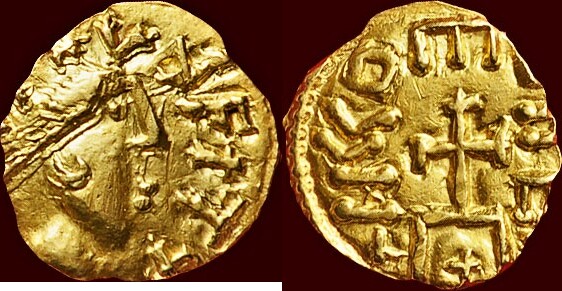
Tremissis FRANKISH EMPIRE - MEROVINGIAN DYNASTY - NEUSTRIA - MONEYER ANGLUS I - n.d. , Quentovic (Wicco in Pontio) xf-/xf

3750,00 EUR
Differenzbesteuert
zzgl. 18,00 EUR Versand ( nach Deutschland )
Lieferzeit: 5 - 8 Tage*
zzgl. 18,00 EUR Versand ( nach Deutschland )
| Bestellhotline +49 (0)2871 2180 383 |
| Zahlungsarten |
| Überweisung |
xf-/xf | Abkürzungen
12,00 mm
weight 1,27gr. | gold Ø 12mm.
moneyer Anglus I, circa 625-635
obv. Diademed male head to right, surrounded by the legend
(WI) CVS FIT +
rev. Cross potent set on base with small cross below,
surrounded by the legend ΛNLLO MONE
Quentovic was founded by a Neustrian king in the early 6th century. it was one of the two most prominent Frankish ports in the north (the other being Dorestad).The earliest minted coins from Quentovic date from the 6th century. Merchants located in Quentovic would have been primarily Frankish, Saxon, or Frisian. In a trading centre like this, they would have set up permanent shelters and also would have built warehouses to store their goods during the winter months. Trade with the Anglo-Saxons, mainly in Kent (and possibly in Hampshire), was vital for the community. Exports to England would have been primarily textiles although they would have also included wine and quern-stones. In Kent, pottery bottles, glasses, textiles, and gold coins from the early 8th have been discovered, all produced by the Franks. Slaves and other goods would have also been exchanged in Quentovic. The earliest mention of Quentovic in literary text was originally believed to have been written in a charter by Dagobert I. It concerned merchants who were travelling to the fair of St-Denis to trade. This charter is now recognized to be a forgery and was most likely written by someone in the late 9th century. Although Quentovic was mainly an economic centre, because of its location it was also a place where people would pass through in their travels. Finally it was abandoned in the 11th century.
The mintname WICVS/WICCO stands for Wicco in Pontio, which we know as (Carolingian) Quentovic. It was situated near the village of Vic-en-Ponthieu in the department Pas-de-Calais. The name of the moneyer, Anglo, is probably related to the people of the Anglo-Saxons. There were two moneyers working with this name, probably father (Anglus I, circa 625-635) and son (Anglus II, circa 660-675). This coin is from Anglus I. It is certainly no coincidence that the name pops up in the main port city of Northern France. As Quentovic was the most important harbour of Northern France, pilgrims from England arrived here during their pilgrimage to Rome (see Felder. E: Die Personennamen auf merowingischen Münzen der Biblithèque nationale de France, München 2003, page 59). Rare and highly interesting historical coin.
cf. Belfort 4989 | cf. Prou 1132 | MEC- |
cf. Lafaurie, RN (1996), type VIII b, 54 |
cf. Depeyrot II, page 56, type 20-4A, no.17 R
Very attractive specimen with an attractive portrait.
xf-/xf
Bitte beachten Sie unsere Mindestabnahme von 20 Euro. Sendungen nach China sind auf Gefahr des Käufers und nur Zahlung per banküberweisung. An PayPal und Kreditkarte Zahlungen sind immer Verwaltungs- und Risikokosten verbunden. Sendungen nach Russland, Ukraine und israel sind nicht möglich. Der Versand erfolgt innerhalb von 5 Tagen nach Zahlungseingang. BITTE KEIN PAYPAL ODER KREDITKARTE ZAHLUNGEN FÜR EU. Zahlen Sie bitte immer nur mit IBAN; schnell, billig und zuverlässich.

Informationen zum Kauf bei MA-Shops
Bestellungen bei MA-Shops sind jederzeit möglich und werden innerhalb von 2-4 Arbeitstagen verschickt.
Ein über die MA-Shops abgesicherter Kauf findet niemals außerhalb von MA-Shops statt.
Bestellen Sie sicher online mit dem MA-Shops Warenkorb.
Vielen Dank.
Ein über die MA-Shops abgesicherter Kauf findet niemals außerhalb von MA-Shops statt.
Bestellen Sie sicher online mit dem MA-Shops Warenkorb.
Vielen Dank.
|
Vertrag widerrufen Verkäufer-Startseite | 0Warenkorb | AGB | Impressum | MA AGB | Datenschutzerklärung | Garantie | MA-Shops Neuzugänge Copyright ® 2001-2026, MA-SHOPS Muenzen All Rights Reserved. Designated trademarks and brands are the property of their respective owners. |