

Filter und Sortierung
Bewertungen Henzen

Excellent!
Zoals altijd snelle levering. Produkt als omschreven. Topverkoper!
ik ben heel tevreden keurig geleverd en goede kwaliteit
Nice coin. Well packaged. Good accompanying description.
MA-ID: 8454302010
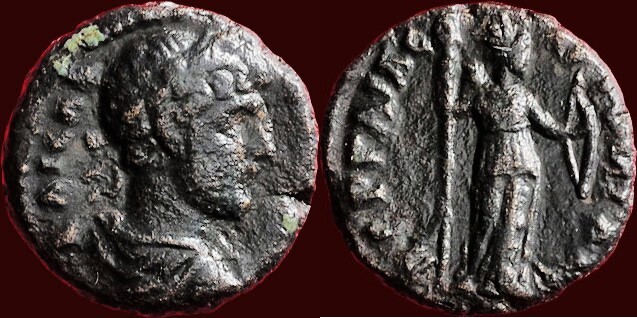
Roman Empire 117-138 n. Chr. HADRIANUS (HADRIAN), 117-138 - PAMPHYLIA - AE 13, Perga vf-/vf

125,00 EUR
Differenzbesteuert
zzgl. 11,00 EUR Versand ( nach Deutschland )
Lieferzeit: 5 - 8 Tage*
| Bestellhotline +49 (0)2871 2180 383 |
| Zahlungsarten |
| Überweisung |
vf-/vf | Abkürzungen
13,00 mm
weight 2,37gr. | bronze Ø 13mm.
obv. Laureate bust of Hadrianus right, wearing cuirass and paludamentum,
seen from rear, surrounded by the legend ΑΔΡΙΑΝΟϹ ΚΑΙϹΑΡ
rev. Artemis with radiate crown standing right, quiver at left shoulder,
resting with her right hand on torch, holding bow in her left,
surrounded by the legend ΑΡΤΕΜΙΔΟϹ ΠΕΡΓΑΙΑϹ
Perga was an ancient and important city of Pamphylia, between the rivers Catarrhactes and Cestrus. Its history goes back to before 1000 BC. A treaty between the Hittite Great King Tudhaliya IV (1239-1209 BC) and his vassal, the king of Tarhuntassa, defined the latter′s western border at the city ″Parha″ and the ″Kastaraya River″. The river is assumed to be the classical Cestrus. West of Parha were the ″Lukka Lands″. Parha likely spoke a late Luwian dialect like Lycian and that of the neo-Hittite kingdoms.
Perga returns to history as a Pamphylian Greek city, and with Pamphylia came under successive rule by Persians, Athenians, and Persians again. Alexander the Great, after quitting Phaselis, occupied Perga with a part of his army. The road between these two towns is described as long and difficult. Alexander′s rule was followed by the Diadochi empire of the Seleucids, then the Romans. Perga gained renown for the worship of Artemis, whose temple stood on a hill outside the town, and in whose honour annual festivals were celebrated. The coins of Perga represent both the goddess and her temple. In 46 AD, according to the Acts of the Apostles, St. Paul journeyed to Perga, from there continued on to Antiocheia in Pisidia, then returned to Perga where he preached the word of God (Acts 14:25). Then he left the city and went to Attaleia. As the Cestrus silted up over the late Roman era, Perga declined as a secular city. In the first half of the 4th century, during the reign of Constantine the Great (324-337), Perga became an important centre of Christianity, which soon became the official religion of the Roman Empire. The city retained its status as a Christian centre in the 5th and 6th centuries.
BMC- | SNG.Copenhagen 317 | SNG.Paris 402 | SNG.von Aulock -
SNG.Pfälzer 285-286 | RPC.III., 2701 | Sear GIC 1208
vf-/vf
Bitte beachten Sie unsere Mindestabnahme von 20 Euro. Sendungen nach China sind auf Gefahr des Käufers und nur Zahlung per banküberweisung. An PayPal und Kreditkarte Zahlungen sind immer Verwaltungs- und Risikokosten verbunden. Sendungen nach Russland, Ukraine und israel sind nicht möglich. Der Versand erfolgt innerhalb von 5 Tagen nach Zahlungseingang. BITTE KEIN PAYPAL ODER KREDITKARTE ZAHLUNGEN FÜR EU. Zahlen Sie bitte immer nur mit IBAN; schnell, billig und zuverlässich.


Informationen zum Kauf bei MA-Shops
Bestellungen bei MA-Shops sind jederzeit möglich und werden innerhalb von 2-4 Arbeitstagen verschickt.
Ein über die MA-Shops abgesicherter Kauf findet niemals außerhalb von MA-Shops statt.
Bestellen Sie sicher online mit dem MA-Shops Warenkorb.
Vielen Dank.
|
Vertrag widerrufen Verkäufer-Startseite | 0Warenkorb | AGB | Impressum | MA AGB | Datenschutzerklärung | Garantie | MA-Shops Neuzugänge Copyright ® 2001-2026, MA-SHOPS Muenzen All Rights Reserved. Designated trademarks and brands are the property of their respective owners. |