

MA-ID: 8203702010
Bewertungen Henzen

????
Perfect!
Tip-Top Danke
Iedere aankoop dik in orde. Graag tot een volgende keer.
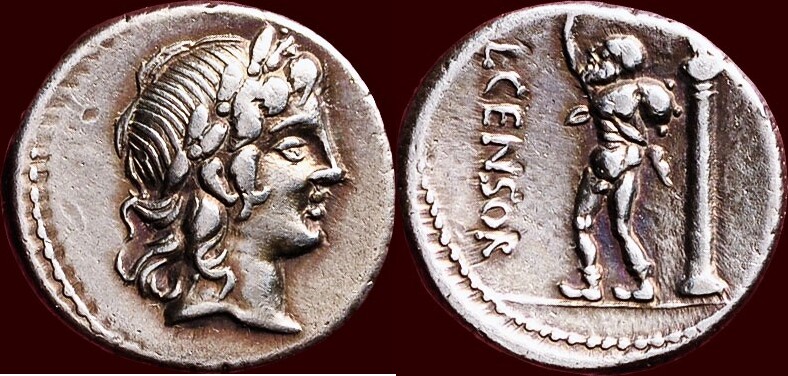
AR Denarius ROMAN REPUBLIC - LUCIUS MARCIUS CENSORINUS - Rome (cf. Künker Auktion 367, lot 7766 in xf-/xf: € 650 + 25%)
Munthandel G.Henzen 
11
Seit 11 Jahren bei MA-Shops
8018 Bewertungen,
100 % Positiv (seit 24 Monaten)
Weltweiter Versand
475,00 EUR
Differenzbesteuert
zzgl. 11,00 EUR Versand ( nach Deutschland )
Lieferzeit: 5 - 8 Tage*
zzgl. 11,00 EUR Versand ( nach Deutschland )
| Bestellhotline +49 (0)2871 2180 383 |
| Zahlungsarten |
| Überweisung |
(cf. Künker Auktion 367, lot 7766 in xf-/xf: € 650 + 25%) | Abkürzungen
16,00 mm
weight 3,77gr. | silver Ø 16mm.
obv. Laureate head of Apollo right
rev. The satyr Marsyas walking left with his right arm raised,
carrying skin made winesack over left shoulder, column with
Apollo playing the lyre behind, L•CENSOR before
The Marcii Censorini were a branch of the plebeian gens Marcia, but Ronald Syme notes their ″ancestral prestige, barely conceding precedence to the patriciate.″ They had been supporters of Caius Marius and were consistent populares throughout the civil wars of the 80s and 40s–30s. Lucius Marcius Censorinus was one of Sulla′s enemies in 88 BC. He was apponted monetalis of Rome in 82 BC, and an officer, perhaps prefect of the fleet in 70 BC. The cognomen Censorinus was acquired through Caius Marcius Rutilus, in 357 BC the first elected consul, whose son used it. The gens Marcia claimed descent from both Ancus Marcius, a king of Rome, and symbolically from Marsyas the satyr, who was associated with free speech and political liberty.
According to the usual Greek version, Marsyas found the aulos (double pipe) that the goddess Athena had invented and thrown away and, after becoming skilled in playing it, challenged Apollo to a contest with his lyre. There are several versions of the contest according to Hyginus, Marsyas was departing as victor after the first round, when Apollo, turning his lyre upside down, played the same tune. This was something that Marsyas could not do with his flute. According to Diodorus Siculus, Marsyas was defeated when Apollo added his voice to the sound of the lyre. Marsyas protested, arguing that the skill with the instrument was to be compared, not the voice. However, Apollo replied that when Marsyas blew into the pipes, he was doing almost the same thing himself. The Nysean nymphs supported Apollo′s claim, leading to his victory. Marsyas was tied to a tree and flayed him. His skin was displayed at Calaenae in southern Phrygia, as the Greek historians Herodotus and Xenophon report.
Yet another version states that Marsyas played the flute out of tune, and hence accepted his defeat. Out of shame, he assigned to himself the penalty of being skinned for a winesack. This version is depicted on this coin.
On the reverse of this coin a statue is depicted located in the forum near the praetorian tribunal. Copies of this statue in various cities of the empire later announced that the respective city had been gifted with the Ius Italicorum.
Crawford 363/1 | Sydenham 737 | Albert 1254 | Sear 281
(cf. Künker Auktion 367, lot 7766 in xf-/xf: € 650 + 25%)
very attractive specimen with fine details
xf-
Bitte beachten Sie unsere Mindestabnahme von 20 Euro. Sendungen nach China sind auf Gefahr des Käufers und nur Zahlung per banküberweisung. An PayPal und Kreditkarte Zahlungen sind immer Verwaltungs- und Risikokosten verbunden. Sendungen nach Russland, Ukraine und israel sind nicht möglich. Der Versand erfolgt innerhalb von 5 Tagen nach Zahlungseingang. BITTE KEIN PAYPAL ODER KREDITKARTE ZAHLUNGEN FÜR EU. Zahlen Sie bitte immer nur mit IBAN; schnell, billig und zuverlässich.


Informationen zum Kauf bei MA-Shops
Bestellungen bei MA-Shops sind jederzeit möglich und werden innerhalb von 2-4 Arbeitstagen verschickt.
Ein über die MA-Shops abgesicherter Kauf findet niemals außerhalb von MA-Shops statt.
Bestellen Sie sicher online mit dem MA-Shops Warenkorb.
Vielen Dank.
Ein über die MA-Shops abgesicherter Kauf findet niemals außerhalb von MA-Shops statt.
Bestellen Sie sicher online mit dem MA-Shops Warenkorb.
Vielen Dank.
|
Vertrag widerrufen Verkäufer-Startseite | 0Warenkorb | AGB | Impressum | MA AGB | Datenschutzerklärung | Garantie | MA-Shops Neuzugänge Copyright ® 2001-2026, MA-SHOPS Muenzen All Rights Reserved. Designated trademarks and brands are the property of their respective owners. |