


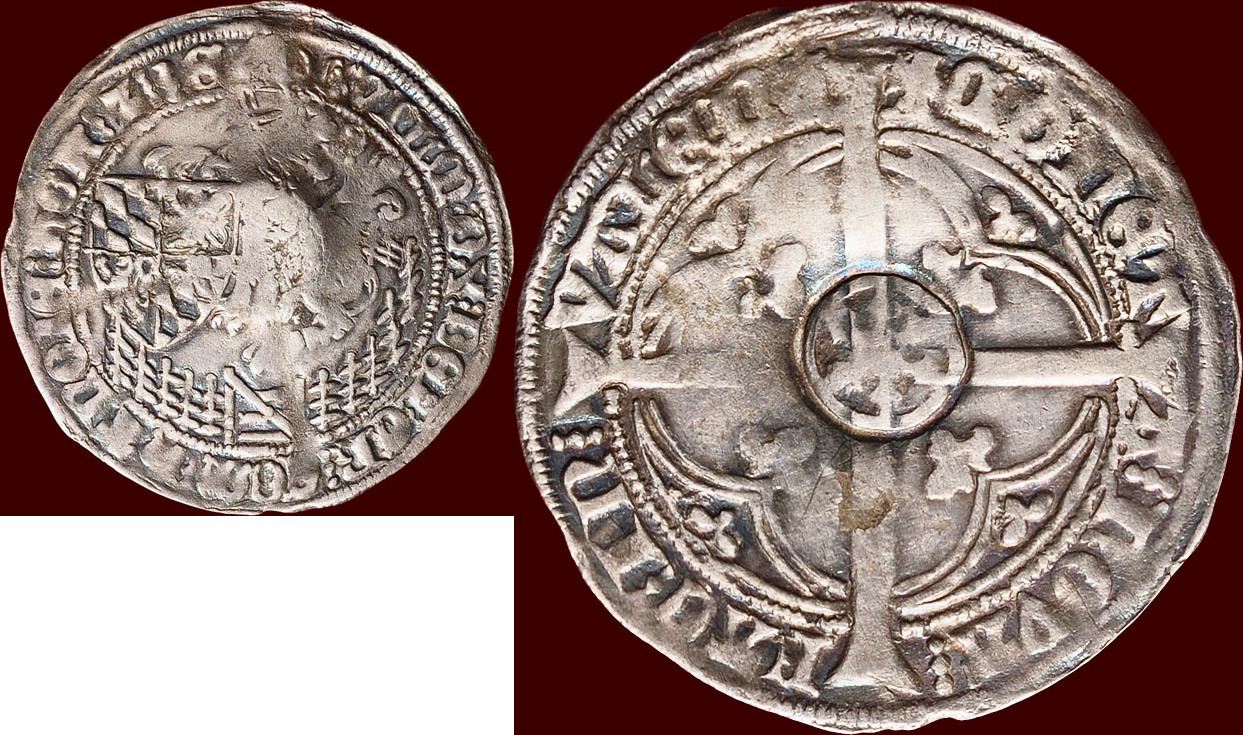
Dubbele groot 1404-1417 ZUIDELIJKE NEDERLANDEN (SOUTHERN NETHERLANDS) - GRAAFSCHAP HENEGOUWEN (HAINAUT) - WILLEM IV VAN BEIEREN, - of thuyne z.j., Val zfr

zzgl. 13,00 EUR Versand ( nach Deutschland )
| Bestellhotline +49 (0)2871 2180 383 |
| Zahlungsarten |
| Überweisung |
vz. Leeuw zittend naar links met voor zich het wapenschild van Beieren-
Henegouwen, binnen een door hek gesloten omheining, binnen een parelcirkel
omringd door de tekst GVILM⋮DX⋮DЄI⋮GR⋮COM⋮HANOIЄ⋮HOL⋮Z⋮ZЄ′
kz. Lang gevoet kruis geplaatst over een parelcirkel en dubbel gelijnde vierpas
met bladversieringen bij de inbuigingen, omringd door de tekst
✠ MONЄT - A⋮NOVA⋮ - FAC⋮IN⋮ – VALЄNC
Willem IV van Beieren (Willem VI voor Holland) werd op 5 april 1365 geboren te ′s-Gravenhage als zoon van Albrecht van Beieren en Margaretha van Brieg. Toen zijn vader Albrecht in 1404 overleed volgde hij hem als graaf Willem VI van Holland en Zeeland op. Tevens was hij als Willem II hertog van Beieren-Straubing en als Willem IV graaf van Henegouwen. Willem was in 1385 gehuwd met Margaretha van Bourgondië, een dochter van Philips de Stoute. Uit dit huwelijk werd een kind geboren, hun dochter Jacoba van Beieren. Willem overleed op 31 mei 1417 in het Henegouwse Bouchain en werd begraven in de kerk van de Minderbroeders in Valenciennes in Henegouwen. Jacoba van Beieren volgde hem op als gravin van Holland, Zeeland en Henegouwen.
Na het overlijden van Willem IV, brak een strijd uit om de erfenis van Willem IV. Hij werd opgevolgd door zijn dochter Jacoba van Beieren, maar ook Philips de Goede van Bourgondië maakte aanspraak op de titels van Henegouwen en Holland. Na enige strijd was Jacoba in 1428 gedwongen om tot een akkoord met Philips de Goede te komen. Bij de ″Zoen van Delft″ werd Jacoba op 3 juli 1428 in naam als wettige landsvrouwe erkend, doch de macht kwam feitelijk in handen van haar neef Philips de Goede. In 1433 werd zij gedwongen terug te treden ten gunste van Philips de Goede en gingen Henegouwen en Holland definitief over in Bourgondische handen.
William IV of Bavaria (William VI for Holland) was born on 5 April 1365, in The Hague as the son of Albert of Bavaria and Margaret of Brieg. When his father Albert died in 1404, he succeeded him as Count William VI of Holland and Zeeland. He was also Duke of Bavaria-Straubing as William II and Count of Hainaut as William IV. William married Margaret of Burgundy, a daughter of Philip the Bold, in 1385. One child was born from this marriage, their daughter James of Bavaria. William died on 31 May 1417, in Bouchain, Hainaut, and was buried in the church of the Friars Minor in Valenciennes, Hainaut. Jacoba van Beieren (Jeanne of Bavaria) succeeded him as Countess of Holland, Zeeland, and Hainaut.
After the death of William IV of Bavaria (Willem VI for Holland) in 1417, a battle broke out over the inheritance of William IV. He was succeeded by his daughter Jacoba van Beieren (Jeanne of Bavaria), but Philip the Good of Burgundy also claimed the titles of Hainaut and Holland. After some struggle, Jacoba was forced to come to an agreement with Philip the Good in 1428. At the ″Zoen van Delft″ Jacoba was officially recognized as the legal countess of Hainaut and Holland on July 3, 1428, but the power actually fell into the hands of her cousin Philip the Good. In 1433 she was forced to abdicate in favor of Philip the Good and Hainaut and Holland finally passed into Burgundian hands.
Op de keerzijde is een instempeling “rad” aangebracht door de stad Osnabrück. De Westfaalse steden werden overspoeld door buitenlands geld o.a. uit de Nederlanden. In diverse steden werden de stukken die qua gehalte en gewicht aan de voorschriften voldeden voorzien van een instempeling, zo ook in Osnabrück. Zo wist de bevolking in Westfalen welke munten ze als betaling konden accepteren en welke niet. (zie kennepohl 152g en Krusy O2,6j). Interessant en zeldzaam.
On the reverse we see the countermark “rad” by the city of Osnabrück. The Westphalian cities were flooded by foreign money, including from the Low Countries. In various cities, the pieces that met the requirements in terms of content and weight were countermarked, also in Osnabrück. This way, the people of Westphalia knew which coins they could accept as payment and which they could not. (see kennepohl 152g and Krusy O2.6j). Interesting and rare.
Chalon 137 | de Mey 149 | van der Chijs 9,17 (Holland) | Lucas 160 | Vanhoudt G.559
zfr
Bitte beachten Sie unsere Mindestabnahme von 20 Euro. Sendungen nach China sind auf Gefahr des Käufers und nur Zahlung per banküberweisung. An PayPal und Kreditkarte Zahlungen sind immer Verwaltungs- und Risikokosten verbunden. Sendungen nach Russland, Ukraine und israel sind nicht möglich. Der Versand erfolgt innerhalb von 5 Tagen nach Zahlungseingang. BITTE KEIN PAYPAL ODER KREDITKARTE ZAHLUNGEN FÜR EU. Zahlen Sie bitte immer nur mit IBAN; schnell, billig und zuverlässich.

Ein über die MA-Shops abgesicherter Kauf findet niemals außerhalb von MA-Shops statt.
Bestellen Sie sicher online mit dem MA-Shops Warenkorb.
Vielen Dank.
|
Vertrag widerrufen Verkäufer-Startseite | 0Warenkorb | AGB | Impressum | MA AGB | Datenschutzerklärung | Garantie | MA-Shops Neuzugänge Copyright ® 2001-2026, MA-SHOPS Muenzen All Rights Reserved. Designated trademarks and brands are the property of their respective owners. |