

MA-ID: 8048402010
Bewertungen Henzen

Sehr schnelle Lieferung und Münze
tres belle piece. Felicitations
Great coins, fast delivery, all good!
????
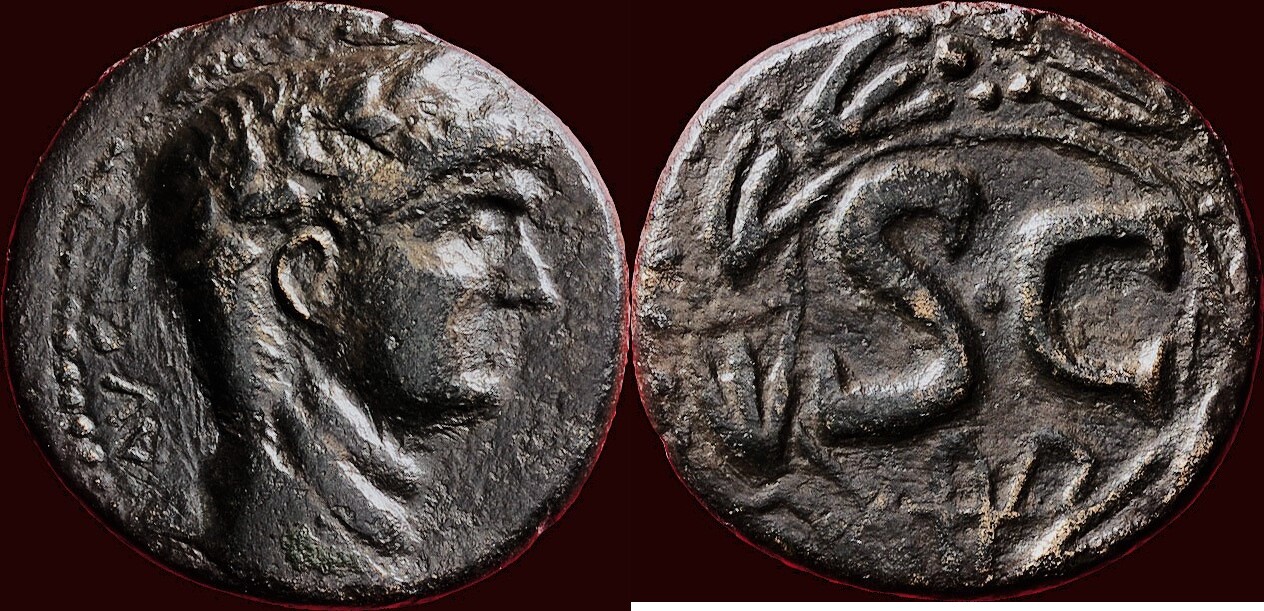
Roman Empire 41-54 n. Chr. CLAUDIUS, 41-54 - SYRIA - Diassarion, Antiochia ad Orontem f/vf à vf-
Munthandel G.Henzen 
11
Seit 11 Jahren bei MA-Shops
8026 Bewertungen,
100 % Positiv (seit 24 Monaten)
Weltweiter Versand
145,00 EUR
Differenzbesteuert
zzgl. 11,00 EUR Versand ( nach Deutschland )
Lieferzeit: 5 - 8 Tage*
zzgl. 11,00 EUR Versand ( nach Deutschland )
| Bestellhotline +49 (0)2871 2180 383 |
| Zahlungsarten |
| Überweisung |
f/vf à vf- | Abkürzungen
26,00 mm
weight 14,50gr. | bronze Ø 26mm.
obv. Bare head of Claudius right, surrounded by the legend
IM•TI•CLA•CAE - AV•GER• (only partially readable)
rev. Large S C within circle, surrounded by a laurel wreath,
tied at the bottom with a cord, with two loops, a thick dot
at the top (S C is the Latin abbreviation for Senatus Consulto,
which means ′by decree of the Senate′)
This coin type was minted under Caius Cassius, Caius filius Longinus. Caius Cassius Longinus was a Roman jurist and politician from the first century AD. A grandnephew of Servius Sulpicius Rufus, he was also a nephew or great-grandson of Caius Cassius Longinus, one of Caesar′s assassins. Cassius Longinus was suffect consul of the second half of the year 30 as the colleague of Lucius Naevius Surdinus. He married Junia Lepida, a descendant of Augustus. They had two children: Cassia Longina (born c. AD 35), who married the general Cnaeus Domitius Corbulo, and Cassius Lepidus (born c. AD 55). The latter married an unknown woman by whom he had a daughter, Cassia Lepida (born c. AD 80). She married Caius Julius Alexander Berenicianus consul in AD 116 and proconsul of Asia in AD 132.
His son-in-law, general Cnaeus Domitius Corbulo, ordered during his stay in Germania, the construction of a canal between the rivers Rhine and Meuse. Parts of this engineering work, known as Fossa Corbulonis or Corbulo′s Canal (Dutch: Corbulogracht of kanaal van Corbulo), have been found at archaeological digs. It ran largely parallel to the modern-day Vliet canal, which connects the modern Dutch towns of Leiden (ancient Matilo) and Voorburg (Forum Hadriani).
After completing his term as suffect consul, Cassius Longinus served as proconsular governor of Asia in 40–41, then governor of the imperial province of Syria in 41–49. He was exiled by Nero to Sardinia in 65, but returned to Rome when Vespasianus acceded to the purple.
Tacitus includes a speech of Cassius Longinus, when he was a senator in the time of Nero, on the debate that arose when there had been mass protests in Rome when 400 innocent slaves were to be executed because they belonged to the household of Lucius Pedanius Secundus who had been murdered by his slave. It is open to question as to what extent the speech we have reflected what Cassius actually said, and to what extent it represents Tacitus′s views, though it is at least possible that Tacitus made use of the Senate′s records the hard line expressed is in line with what we know about Cassius. In the speech Cassius conceded that the execution would be unjust. He also conceded it violated the rights of private interests but justified it on the grounds of the public good. The private interests that concerned him did not include any right to life for the slaves but the loss to the heirs. Modern commentators side with those who protested at the time in regarding the law as inherently unjust.
Struck during the time Saint Paul stayed in Antiochia ad Orontem (ca.44-45 AD) on his missionary journeys. It was at Antiochia ad Orontem that believers in Jesus Christ were first called Christians.
BMC 166–7 | McAlee 250 | Butcher 97ii
cf. SNG.Copenhagen 150-151 | RPC I 4279
attractive dark patina
f/vf à vf-
Bitte beachten Sie unsere Mindestabnahme von 20 Euro. Sendungen nach China sind auf Gefahr des Käufers und nur Zahlung per banküberweisung. An PayPal und Kreditkarte Zahlungen sind immer Verwaltungs- und Risikokosten verbunden. Sendungen nach Russland, Ukraine und israel sind nicht möglich. Der Versand erfolgt innerhalb von 5 Tagen nach Zahlungseingang. BITTE KEIN PAYPAL ODER KREDITKARTE ZAHLUNGEN FÜR EU. Zahlen Sie bitte immer nur mit IBAN; schnell, billig und zuverlässich.

Informationen zum Kauf bei MA-Shops
Bestellungen bei MA-Shops sind jederzeit möglich und werden innerhalb von 2-4 Arbeitstagen verschickt.
Ein über die MA-Shops abgesicherter Kauf findet niemals außerhalb von MA-Shops statt.
Bestellen Sie sicher online mit dem MA-Shops Warenkorb.
Vielen Dank.
Ein über die MA-Shops abgesicherter Kauf findet niemals außerhalb von MA-Shops statt.
Bestellen Sie sicher online mit dem MA-Shops Warenkorb.
Vielen Dank.
|
Vertrag widerrufen Verkäufer-Startseite | 0Warenkorb | AGB | Impressum | MA AGB | Datenschutzerklärung | Garantie | MA-Shops Neuzugänge Copyright ® 2001-2026, MA-SHOPS Muenzen All Rights Reserved. Designated trademarks and brands are the property of their respective owners. |