

MA-ID: 7951902010
Bewertungen Henzen

Sehr schnelle Lieferung und Münze
tres belle piece. Felicitations
Great coins, fast delivery, all good!
????
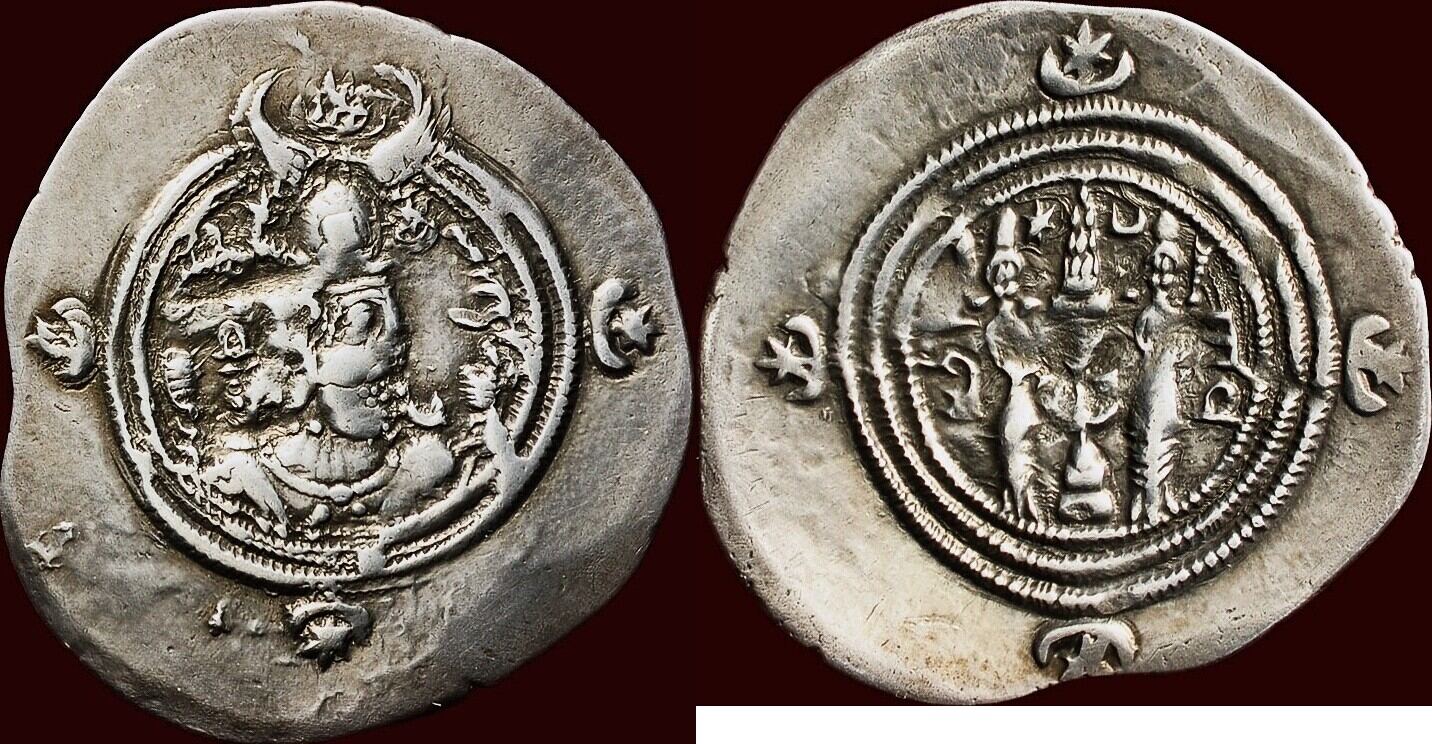
AR Drachm 590-628 n. Chr. IRAN (PERSIA) - SASANIAN KINGDOM - KHOSROW (KHUSRO) II, - Ardashir-Khurra (Pars district) vf-
Munthandel G.Henzen 
11
Seit 11 Jahren bei MA-Shops
8026 Bewertungen,
100 % Positiv (seit 24 Monaten)
Weltweiter Versand
60,00 EUR
Differenzbesteuert
zzgl. 9,50 EUR Versand ( nach Deutschland )
Lieferzeit: 5 - 8 Tage*
zzgl. 9,50 EUR Versand ( nach Deutschland )
| Bestellhotline +49 (0)2871 2180 383 |
| Zahlungsarten |
| Überweisung |
vf- | Abkürzungen
32,00 mm
weight 4,05gr. | silver Ø 32mm.
obv. Bust of Khosrow right, wearing winged crown surmounted
by star-in-crescent, ribbons rising from shoulders, Pahlawi legend
to left and right, in double reeded border, star-in-crescent at 3,6
and 9 o′clock.
The Pahlawi legend can be translated as ′may the royal Glory increase Khusru′
rev. Zoroastrian fire altar, an "atasdan" with a capitellum and plates,
near which two attendants wearing headdresses with a crescent with
its ends pointing upwards, stand facing ahead, the narrow part of the
"atasdan" is covered by ribbons, to the left of the fire there is a star,
and to the right a crescent, Pahlavi legend: to the left - the year of his reign
to the right - the mint′s name, there is a triple reeded rim around with four
star-in-crescents in margin at 3, 6, 9 and 12 o′clock Ardashir-Khurra (also known as Ardashir Khwarrah) originally was the ancient Persian city of Gōr. Gōr dates back to the Achaemenid era. It was situated in a low-lying area of the region, so, during his invasion of Persia, Alexander the Great was able to drown the city by directing the flow of a river into the city. The lake he created remained until Ardashir I (180-242 AD) built a tunnel to drain it. He founded his new capital city on this site. Ardashir′s new city was known as Khor Ardashīr, Ardashīr Khurrah (or Khwarrah) and Gōr. Ardashir-Khwarrah, meaning ″glory of Ardashir″, was one of the four (later five) administrative divisions of the Sasanian province of Pars. The other administrative divisions were Shapur-Khwarrah, Istakhr and Darabgird, while a fifth named Arrajan was founded in the early 6th century by Kavadh I (r. 498–531). The city had a circular plan so precise in measurement that the Persian historian Ibn Balkhi wrote it to be "devised using a compass". It was protected by a trench 50 meters in width, and was 2 kilometers in diameter. The city had four gates to the north was the Hormozd Gate, to the south the Ardashir Gate, to the east the Mithra Gate and to the west the Wahram Gate. The royal capital′s compounds were constructed at the center of a circle 450 m in radius. At the center of the town there was a lofty platform or tower, called Terbal. It was 30 m high and spiral in design. The design is unique in Iran, and there are several theories regarding the purpose of its construction. It is thought to have been the architectural predecessor of the Great Mosque of Samarra of Iraq and its distinctive minaret, the malwiya.In the Sasanian era, the abbreviation ART (in Inscriptional Pahlavi) was used as the mint signature to refer to Gōr. Gōr and Istakhr strenuously resisted the invading Arab Muslims in the 630s and 640s. In ca. 644, during the Arab invasion of Iran, one of Ardashir-Khwarrah′s subdistricts, Tawwaz, was seized by al-′Ala′ ibn al-Hadrami, who thereafter sent Hormoz ibn Hayyan al-′Abdi to capture Siniz, which he successfully managed to. In 649/50, Abd-Allah ibn Amir made an unsuccessful attempt to capture Gor. In 650/1, the last Sasanian king Yazdegerd III (r. 632–651) went to Gor to plan an organized resistance against the Arabs, but after receiving the news of Istakhr′s fall, fled to Kirman. The Arabs then quickly seized Gor, Siraf, and the rest of Pars. Pars was a Sasanian province in Late Antiquity, which almost corresponded to the present-day province of Fars. The province bordered Khuzestan in the west, Kirman in the east, Spahan in the north, and Mazun in the south. The Middle Persian name of ″Pārs″ is derived from Pārsā, the Old Persian of the region. The English name Persia and Greek name Persis derives from this region. The city′s importance was revived again in the reign of Fanna Khusraw (949-983 AD) of the Buyid dynasty, who frequently used the city as his residence. It is at this time that the old name of the city, Gōr, was abandoned in favor of the new. In New Persian, spoken at the time, the word Gōr (گور) had come to mean "grave". King Adud al-Dawla, as the story goes, found it distasteful to reside in a "grave". Per his instruction, the city′s name was changed to Peroz-abad, "City of Victory." Since then, the city has been known by variations of that name, including Firuzabad. This is still the name by which we know the city today. cf. Mitchiner ACW.1120var. | cf. Göbl 210
struck with the usual weaknesses
vf-
Bitte beachten Sie unsere Mindestabnahme von 20 Euro. Sendungen nach China sind auf Gefahr des Käufers und nur Zahlung per banküberweisung. An PayPal und Kreditkarte Zahlungen sind immer Verwaltungs- und Risikokosten verbunden. Sendungen nach Russland, Ukraine und israel sind nicht möglich. Der Versand erfolgt innerhalb von 5 Tagen nach Zahlungseingang. BITTE KEIN PAYPAL ODER KREDITKARTE ZAHLUNGEN FÜR EU. Zahlen Sie bitte immer nur mit IBAN; schnell, billig und zuverlässich.


Informationen zum Kauf bei MA-Shops
Bestellungen bei MA-Shops sind jederzeit möglich und werden innerhalb von 2-4 Arbeitstagen verschickt.
Ein über die MA-Shops abgesicherter Kauf findet niemals außerhalb von MA-Shops statt.
Bestellen Sie sicher online mit dem MA-Shops Warenkorb.
Vielen Dank.
Ein über die MA-Shops abgesicherter Kauf findet niemals außerhalb von MA-Shops statt.
Bestellen Sie sicher online mit dem MA-Shops Warenkorb.
Vielen Dank.
|
Vertrag widerrufen Verkäufer-Startseite | 0Warenkorb | AGB | Impressum | MA AGB | Datenschutzerklärung | Garantie | MA-Shops Neuzugänge Copyright ® 2001-2026, MA-SHOPS Muenzen All Rights Reserved. Designated trademarks and brands are the property of their respective owners. |