

MA-ID: 7750802010
Bewertungen Henzen

tres belle piece. Felicitations
Great coins, fast delivery, all good!
????
Perfect!
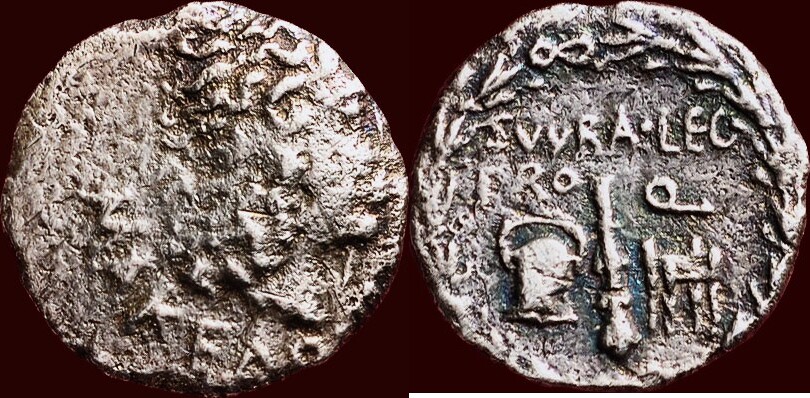
AR Drachm 90 v. Chr. KOINON MACEDONIA – QUINTUS BRAETIUS SURA, LEGATUS PRO QUAESTORE, ca.93-87 BC - Tessalonika, circa 90 BC
Munthandel G.Henzen 
11
Seit 11 Jahren bei MA-Shops
8024 Bewertungen,
100 % Positiv (seit 24 Monaten)
Weltweiter Versand
1350,00 EUR
Differenzbesteuert
zzgl. 18,00 EUR Versand ( nach Deutschland )
Lieferzeit: 5 - 8 Tage*
zzgl. 18,00 EUR Versand ( nach Deutschland )
| Bestellhotline +49 (0)2871 2180 383 |
| Zahlungsarten |
| Überweisung |
17,00 mm
weight 3,45gr. | silver Ø 17mm.
obv. Head of Alexander the Great right, with horn of Ammon and flowing hair,
MAKEΔONΩN beneath
rev. Money-chest (fiscus), club and sella curulis (chair), SVRRA•LEG / PRO,
above Q to right, within olive-wreath
Remarkable coin that bears inscriptions in two different languages. On the obverse Makedonon is written in Greek letters while the reverse features the Latin legens SVVRA LEG PRO Q. Quintus Braetius (also Bruttius) Sura was a Roman legatus pro quaestore in the years 93-87 BC, under the praetor (proconsul) Caius Sentius Saturninus. He was responsible for collecting taxes in de Roman province of Macedonia. On the reverse we see a cista, a basket with a lid as it was used for collecting the Roman taxes. On the right-hand side, there is special kind of chair. Everybody living in the Roman Empire recognized this chair as the one a tax collector, a quaestor, was sitting on when performing his duties. Since the time of their King Lysimachus, between 305 and 281 BC, the Thracians and Macedonians were used to circulating coins that bore the portrait of Alexander the Great. Thus, the Romans depicted Alexander on their coins as well, with flowing hair and the horn of Ammon. The weight of the tetradrachm (ca. 16,80gr). and drachm (ca.4,20gr,) was the same. and corresponded to the widely accepted standard of the Athenian new style tetradrachms. The club was a well-known element of the depiction. Every Thracian and Macedonian knew the club from the tetradrachms the Romans had minted after the Macedonian conquest. The other features of the coin′s imagery, however, were new. We know that the Thracians and Macedonians willingly accepted these coins, and that the Romans kept minting coins of this type bearing the name Aesillas for twenty years, long after Aesillas had left the Province of Macedonia. It was not before the second half of the 1st century that the tetradrachms were replaced by Roman denarii as the most popular currency in Thrace and Macedonia.
On the reverse we see the fiscus the Roman emperor′s treasury (where money was stored in baskets), as opposed to the public treasury (aerarium). It drew money primarily from revenues of the imperial provinces, forfeited property, and the produce of unclaimed lands.
After his task as legatus pro quaetore , Quintus Braetius Sura (also known as Bruttius Sura) was a Roman commander who fought in the First Mithridatic War (89-85 BC). He was the first Roman commander to successfully resist Mithridates′ advance. Coins from Quintus Braetius Sura are sporadically offered. The extremely rare tetradrachm is the only coin type that is still offered with any regularity. Only a few pieces of the drachma are known, which almost never come onto the market. Coin of the highest rarity.
BMC – (cf. pag.20, 87 = tetradrachm) | SNG.Copenhagen -
AMNG.- (cf. pag.73, no.225 = tetradrachm)
Sear- | HGC – (cf. 3, 1111 = tetradrachm) RRRR
off-centered obverse and minor traces of oxidation
f/f+
Bitte beachten Sie unsere Mindestabnahme von 20 Euro. Sendungen nach China sind auf Gefahr des Käufers und nur Zahlung per banküberweisung. An PayPal und Kreditkarte Zahlungen sind immer Verwaltungs- und Risikokosten verbunden. Sendungen nach Russland, Ukraine und israel sind nicht möglich. Der Versand erfolgt innerhalb von 5 Tagen nach Zahlungseingang. BITTE KEIN PAYPAL ODER KREDITKARTE ZAHLUNGEN FÜR EU. Zahlen Sie bitte immer nur mit IBAN; schnell, billig und zuverlässich.

Informationen zum Kauf bei MA-Shops
Bestellungen bei MA-Shops sind jederzeit möglich und werden innerhalb von 2-4 Arbeitstagen verschickt.
Ein über die MA-Shops abgesicherter Kauf findet niemals außerhalb von MA-Shops statt.
Bestellen Sie sicher online mit dem MA-Shops Warenkorb.
Vielen Dank.
Ein über die MA-Shops abgesicherter Kauf findet niemals außerhalb von MA-Shops statt.
Bestellen Sie sicher online mit dem MA-Shops Warenkorb.
Vielen Dank.
|
Vertrag widerrufen Verkäufer-Startseite | 0Warenkorb | AGB | Impressum | MA AGB | Datenschutzerklärung | Garantie | MA-Shops Neuzugänge Copyright ® 2001-2026, MA-SHOPS Muenzen All Rights Reserved. Designated trademarks and brands are the property of their respective owners. |