

MA-ID: 7625602010
Bewertungen Henzen

Great coins, fast delivery, all good!
????
Perfect!
Tip-Top Danke
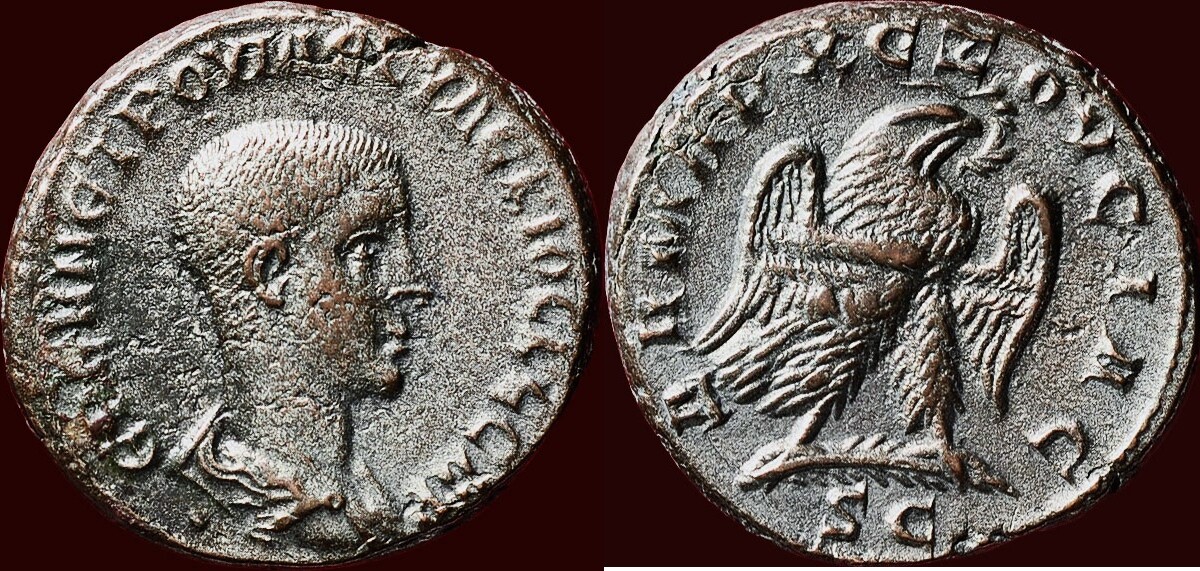
Roman Empire 250-251 n. Chr. HERENNIUS ETRUSCUS as Caesar, 250-251 - SYRIA - SELEUKIS AND PIERIA - BI Tetradrachm, Antiochia vf
Munthandel G.Henzen 
11
Seit 11 Jahren bei MA-Shops
8022 Bewertungen,
100 % Positiv (seit 24 Monaten)
Weltweiter Versand
185,00 EUR
Differenzbesteuert
zzgl. 11,00 EUR Versand ( nach Deutschland )
Lieferzeit: 5 - 8 Tage*
zzgl. 11,00 EUR Versand ( nach Deutschland )
| Bestellhotline +49 (0)2871 2180 383 |
| Zahlungsarten |
| Überweisung |
vf | Abkürzungen
25,00 mm
weight 11,81gr. | billon Ø 25mm.
officina 1 (one dot below bust)
obv. Bare-headed and draped bust of Etruscus, right,
seen from rear below bust: •, surrounded by the legend
ЄPЄNN ЄTPOY MЄ KY ΔЄKIOC KЄCAP
rev. Eagle standing on palm, right, spreading wings,
holding wreath in beak below, S C, surrounded by the legend
ΔHMAPXЄ ЄΞOYCIAC
This coin type was minted in seven mint workshops (officinae) in Antiochia. Officinae 1 through 5 were indicated by 1,2,3,4, or 5 dots below the bust. Officina 6 with the letter S (Ϛ) and officina 7 with the letter Z.
Seleukis and Pieria was an ancient region of ″greater Syria″ that included the northwestern part of modern Syria and southeastern Anatolia in modern Turkey. The main cities of the region in ancient times were: Antiocheia ad Orontem, Apameia, Epiphaneia, Gabala, Laodikea ad Mare, Larissa, Rhosus, Seleukeia Pieria, and Tetrapolis of Seleukis. Pieria is the land surrounding the town of Seleukia, located on the Orontes River, which was built around 300 BC by Seleukos I Nikator, a general of Alexander the Great. The city was the capital of the Seleukid Empire from 240 BC until 63 BC, when the Romans took control, making it the capital of the province of Syria and later of Coele Syria. Briefly conquered by Tigranes II of Armenia, Seleukia was then taken by the Roman general Pompeius Magnus (Pompey the Great), who gave it to Antiochos I Theos of Commagene, at which time the city was renamed Antiochia. Antiochia thrived for centuries as an emporium where the Arabian caravans met the Silk Road caravans met the Mediterranean maritime trade. Philippus I the Arab came to power in a coup against the previous emperor, Gordianus III, who had been young and popular. His entire reign was fighting. He died with his son during a campaign against one of his generals, the future Trajanus Decius, who had been acclaimed Emperor by his troops.
The Romans, as they were building their empire, preferred to let the local coinage arrangements remain in place. As they developed their political system into the Cult of Personality that was the Empire, they started putting imperial portraits on the local coins. Later, as the Empire began to shrink, they preferred to centralize their coinage operations, eliminating local control. There were also allied and client states, some of which, at times, issued coins celebrating the alliance or subservience.
BMC 615-617 | Prieur 629 | Mionnet 320 | SNG.Copenhagen 286var
Sr.GIC.4282var. McAlee 1152a | RPC Online IX, 1699
vf
Bitte beachten Sie unsere Mindestabnahme von 20 Euro. Sendungen nach China sind auf Gefahr des Käufers und nur Zahlung per banküberweisung. An PayPal und Kreditkarte Zahlungen sind immer Verwaltungs- und Risikokosten verbunden. Sendungen nach Russland, Ukraine und israel sind nicht möglich. Der Versand erfolgt innerhalb von 5 Tagen nach Zahlungseingang. BITTE KEIN PAYPAL ODER KREDITKARTE ZAHLUNGEN FÜR EU. Zahlen Sie bitte immer nur mit IBAN; schnell, billig und zuverlässich.

Informationen zum Kauf bei MA-Shops
Bestellungen bei MA-Shops sind jederzeit möglich und werden innerhalb von 2-4 Arbeitstagen verschickt.
Ein über die MA-Shops abgesicherter Kauf findet niemals außerhalb von MA-Shops statt.
Bestellen Sie sicher online mit dem MA-Shops Warenkorb.
Vielen Dank.
Ein über die MA-Shops abgesicherter Kauf findet niemals außerhalb von MA-Shops statt.
Bestellen Sie sicher online mit dem MA-Shops Warenkorb.
Vielen Dank.
|
Vertrag widerrufen Verkäufer-Startseite | 0Warenkorb | AGB | Impressum | MA AGB | Datenschutzerklärung | Garantie | MA-Shops Neuzugänge Copyright ® 2001-2026, MA-SHOPS Muenzen All Rights Reserved. Designated trademarks and brands are the property of their respective owners. |