

MA-ID: 7600202010
Bewertungen Henzen

????
Perfect!
Tip-Top Danke
Iedere aankoop dik in orde. Graag tot een volgende keer.
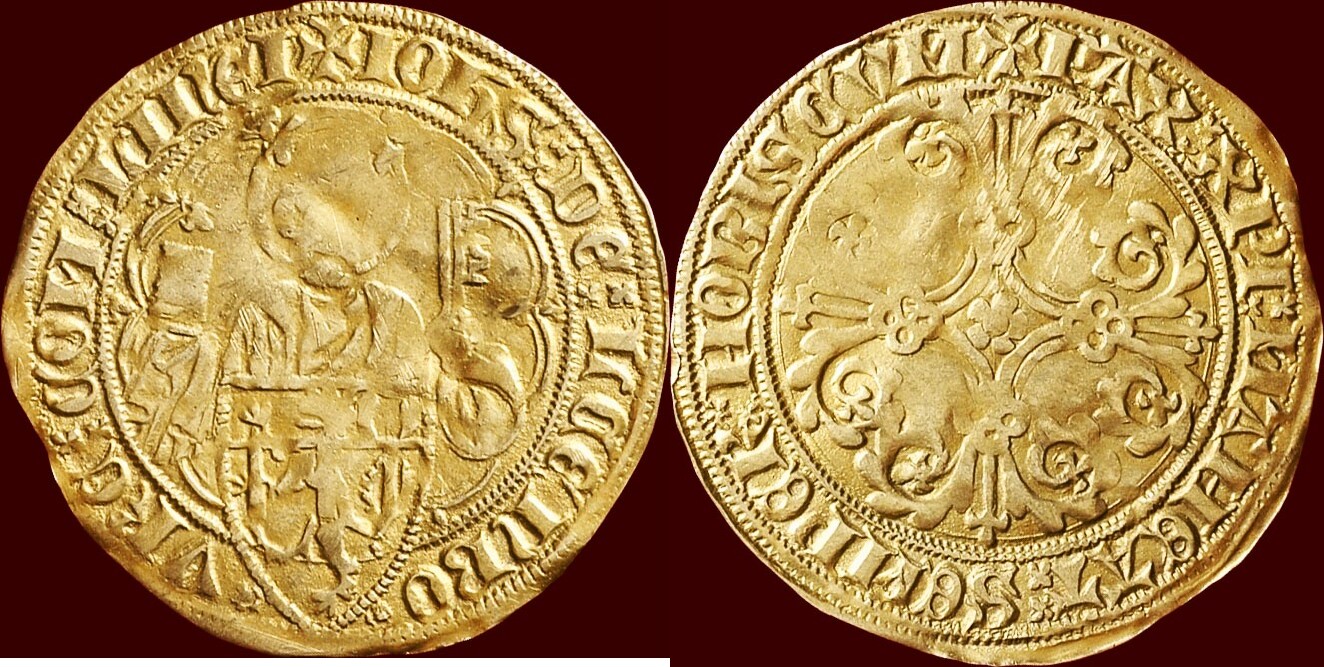
1430-1441 FRANCE - LIGNY, COMTÉ - JEAN II OF LUXEMBURG, - Gold Peter n.d. vf-
Munthandel G.Henzen 
11
Seit 11 Jahren bei MA-Shops
8020 Bewertungen,
100 % Positiv (seit 24 Monaten)
Weltweiter Versand
4500,00 EUR
Differenzbesteuert
zzgl. 18,00 EUR Versand ( nach Deutschland )
Lieferzeit: 5 - 8 Tage*
zzgl. 18,00 EUR Versand ( nach Deutschland )
| Bestellhotline +49 (0)2871 2180 383 |
| Zahlungsarten |
| Überweisung |
vf- | Abkürzungen
28,00 mm
weight 3,53gr. | gold Ø 28mm.
obv. Upper body of Saint Peter with nimbus, with key in the right hand and
the book of the Gospels in the left, surrounded by nine arches within a circle,
below the coat of arms of Luxembourg-Ligny. In the outer circle the text
✠IOhS:DЄ:LCЄNBO* – *VRC:COM:LINЄI
rev. Short flowered and yellowed cross with five-petalled flower in the
diamond-shaped heart within a circle. In the outer circle the text
✠PAX:XPI:MANEAT:SЄMPЄR:NOBISCVM
(translated: the peace of Christ be with us forever)
This is a direct imitation of the golden Pieters of Brabant that were minted under Philips of Saint-Pol (1427-1430) and Philips the Good (1430-1467). Delmonte listed only 3 pieces of this coin type Cabinet de Monnaies & Medailles in Brussels, The Hague and Paris. Extremely rare.
Although the county of Ligny is located in northern France, its coinage is closely related to that of the Netherlands. John II was also a descendant of the house of Luxembourg, with which there is also a connection with the Low Countries in that respect. For this reason, the coinage of the County of Ligny is traditionally classified not only under French numismatics, but also under that of the Low Countries. John II of Luxembourg was born in 1392 as the son of John of Luxembourg-Ligny and Margaret of Brienne. At the start of his career he put himself at the service of Philip the Good, who appointed him governor of Arras in 1414 and governor of Paris from 1418 to 1420. As a descendant of the Chatillons, counts of Sint Pol, he laid claim to the county of Guise, which was strategically located on the border of France and the Netherlands. In 1425 he was confirmed in the post of Count of Guise. It was the time of the Hundred Years War when France was fighting a war against England. The English besieged the city of Orléans in the spring of 1429. At the end of April / beginning of May, the 17-year-old girl Joan of Arc, accompanied by a French army of 4000 men, managed to break this siege and thus became a national heroine. Besides England, Burgundy was also a threat to the French crown. Joan of Arc fought on the French side against the Burgundians at the siege of Compiègne in 1430 and was captured on May 23 by John II of Luxembourg, who was fighting on the Burgundian side. His aim was to get her as large a ransom as possible, for she was already a heroine to the French at that time. However, the French king made no attempt to redeem her. Initially she was imprisoned at Beaulieu Castle, but after an attempt to escape she was placed with his great-aunt Joanna of Luxembourg-Saint-Pol in the castle of Beaurevoir, in Picardy. There she was well received and Johanna, who had much sympathy for Jeanne, pleaded for her release. This went so far that she threatened to disinherit her cousin John II if he did not comply. During Jeanne′s captivity in the keep of Beaurevoir castle, she made another attempt to escape by jumping out of a 21 meter high window of the keep. The attempt failed and she was seriously injured in the fall. However, Joanna of Luxembourg-Saint Pol died on September 18, 1430 and John II inherited the county of Ligny from her. He now also had his hands free to sell Joan of Arc. On November 18, 1430, he sold her for £10,000. Not to the French, but to their nemesis England. She did get a trial for the shape, but that was a farce. To humiliate the French as much as possible, their national heroine Joan of Arc was dismissed as a witch and heretic and for that reason sentenced to death. This means that John II did not play such a nice role in French history. In 1435, during the Peace of Arras, the Burgundians made peace with the French king Charles VII. This peace, however, John II refused to co-sign, much to the will of the French king. When John II died in 1441, King Charles VII decided to take John′s possessions into safekeeping for that reason. His heir Louis of Saint-Pol could not use the possessions. Through reconciliation, Louis was able to restore this later and became the new Count of Ligny. Delmonte 418var. | Poey d′Avant 6891var. | cf. Friedberg 137c RRR
Some weakness and light scratches.
Extremely rare historical coin.
vf-
Bitte beachten Sie unsere Mindestabnahme von 20 Euro. Sendungen nach China sind auf Gefahr des Käufers und nur Zahlung per banküberweisung. An PayPal und Kreditkarte Zahlungen sind immer Verwaltungs- und Risikokosten verbunden. Sendungen nach Russland, Ukraine und israel sind nicht möglich. Der Versand erfolgt innerhalb von 5 Tagen nach Zahlungseingang. BITTE KEIN PAYPAL ODER KREDITKARTE ZAHLUNGEN FÜR EU. Zahlen Sie bitte immer nur mit IBAN; schnell, billig und zuverlässich.


Informationen zum Kauf bei MA-Shops
Bestellungen bei MA-Shops sind jederzeit möglich und werden innerhalb von 2-4 Arbeitstagen verschickt.
Ein über die MA-Shops abgesicherter Kauf findet niemals außerhalb von MA-Shops statt.
Bestellen Sie sicher online mit dem MA-Shops Warenkorb.
Vielen Dank.
Ein über die MA-Shops abgesicherter Kauf findet niemals außerhalb von MA-Shops statt.
Bestellen Sie sicher online mit dem MA-Shops Warenkorb.
Vielen Dank.
|
Vertrag widerrufen Verkäufer-Startseite | 0Warenkorb | AGB | Impressum | MA AGB | Datenschutzerklärung | Garantie | MA-Shops Neuzugänge Copyright ® 2001-2026, MA-SHOPS Muenzen All Rights Reserved. Designated trademarks and brands are the property of their respective owners. |