

MA-ID: 98259600158
Bewertungen CDMA

Ausgezeichneter Anbieter, immer zuverlässig, kann ich nur empfehlen. Vielen...
Alles in einwandfreiem Zustand und wie beschrieben erhalten. Sehr gut verpa...
Good!
Qualität, Verpackung, Lieferzeit ... alles perfekt! Jederzeit wieder gerne!...
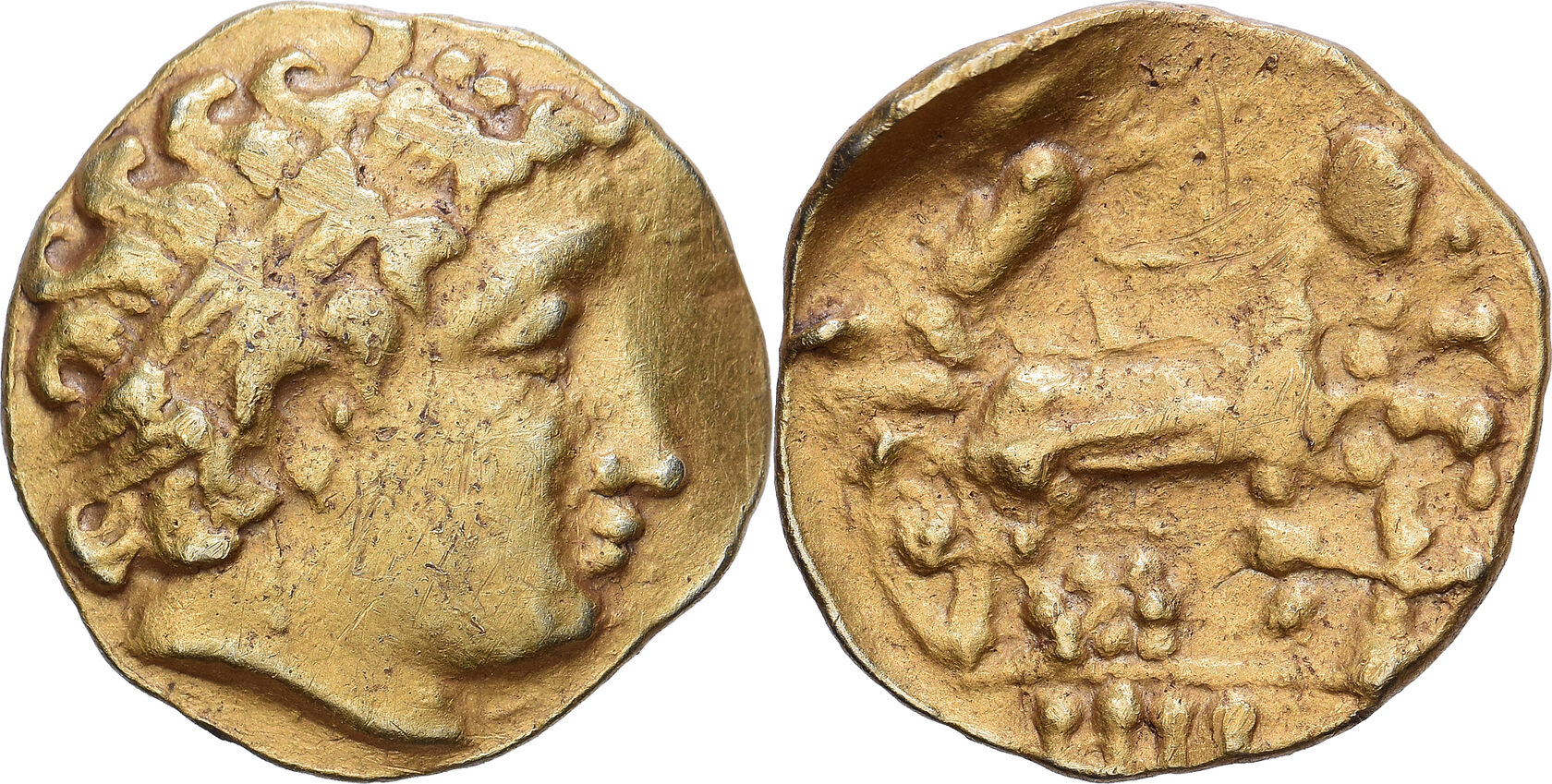
1/4 Stater 3. Jahrhundert v. Chr Not Applic Uncertain, Gold, SS, Delestrée:manque.
Comptoir des Monnaies 
16
Seit 16 Jahren bei MA-Shops
50057 Bewertungen,
99,7 % Positiv (seit 24 Monaten)
Weltweiter Versand
3200,00 EUR
Steuerfrei
zzgl. 4,95 EUR Versand ( nach Deutschland )
Lieferzeit: 6 - 10 Tage*
zzgl. 4,95 EUR Versand ( nach Deutschland )
| Bestellhotline +49 (0)2871 2180 383 |
| Zahlungsarten |
| Überweisung |
Not Applicable
Head of Apollo, laureate, right., Biga galloping to the right, driven by a charioteer brandishing a baton. In the exergue, symbols evoking the legend ‘ΦIΛIΠΠOY’., Quarter stater that appears to be unpublished. The laurel wreath has small scuff marks, and the edge is slightly bent at 3h. We attribute this coin to the large group of the imitations of Philip II's staters that L-P Delestrée includes in his armorican ensemble. It should be noted that, considering the datations of these coinage, it is not possible to link this coin to any Gallic tribe as can be done for later coinage. We believe that it is currently impossible to link this example to any of the examples illustrated by the author in his Nouvel Atlas, Vol. 2. However, we do find similarities with some of them. Note that what look like symbols under the horses are in fact their front and rear legs, but distorted and compressed to fit on the die. The forelegs also show a horizontal die break. We note that the legend has already been largely reduced to a few symbols, vertical ‘I’s with pelleted tips, while the portrait is still with almost all its original ‘Greek’ features and has barely been degenerated. Our attention is turned to the large Normandy group, where we find similarities with example Dt. 2028, whose reverse shows no marks under the horses, and the subsequent example, 2029, which has a portrait with similar features. It seems to us that we must exclude a date later than the first half of the 2nd century, since, as the Nouvel Atlas illustrates it, the types have already much more pronounced Celtic features. As our type has only slightly degenerated, we can estimate that the period of production was between the 3rd century BC and perhaps until the first quarter of the 2nd century BC. However, we cannot exclude the same ensemble, but this time for eastern and central-eastern Gaul. Although there is no symbol on this specimen, we note similarities with the specimens illustrated in the Nouvel Atlas T.3 (Pl. I). This is also observed in the portraits, especially the slightly wavy truncation of the neck of some, a feature we find on our example. We note the example Dt. 3009 (type ‘Montmorot’), whose resemblance is striking. Ultimately, we include our example in the large group of imitations of Philip II by L. -P. Delestrée, linked to the Armorican area, but its unpublished status makes the attribution of its geographical area of minting highly uncertain and serves here more for convenience than as a proper attribution, while in no way excluding a provenance from the east of Celtic territory rather than the west.
Info / FAQ


Informationen zum Kauf bei MA-Shops
Bestellungen bei MA-Shops sind jederzeit möglich und werden innerhalb von 2-4 Arbeitstagen verschickt.
Ein über die MA-Shops abgesicherter Kauf findet niemals außerhalb von MA-Shops statt.
Bestellen Sie sicher online mit dem MA-Shops Warenkorb.
Vielen Dank.
Ein über die MA-Shops abgesicherter Kauf findet niemals außerhalb von MA-Shops statt.
Bestellen Sie sicher online mit dem MA-Shops Warenkorb.
Vielen Dank.
|
Vertrag widerrufen Verkäufer-Startseite | 0Warenkorb | AGB | Impressum | MA AGB | Datenschutzerklärung | Garantie | MA-Shops Neuzugänge Copyright ® 2001-2026, MA-SHOPS Muenzen All Rights Reserved. Designated trademarks and brands are the property of their respective owners. |